
Most business owners view tax season as a defensive hurdle, but the enactment of the One Big Beautiful Bill Act has turned regulatory adherence into a high-stakes growth strategy. It's understandable if you're feeling a sense of modern anxiety over the introduction of Form 1099-DA for digital assets or the increased Social Security wage base of $184,500. Staying ahead of these shifts requires more than just reactive filing; it demands a comprehensive business tax compliance checklist designed to protect your assets while capturing every available incentive.
We recognize that the fear of an IRS audit or the complexity of the reinstated 100% bonus depreciation can be daunting for even the most disciplined entrepreneur. This article promises to replace that uncertainty with a clear, professional roadmap for your 2026 fiscal year. You'll gain a definitive framework for organizing your financial records, meeting critical deadlines like the March 17th cutoff for S-Corps, and leveraging the $2.5 million Section 179 expensing limit to fuel your company's stability and expansion.
Key Takeaways
- Understand the vital distinction between reactive tax preparation and proactive tax planning to align your fiscal obligations with long-term business growth.
- Navigate evolving regulatory requirements with a systematic business tax compliance checklist that organizes entity information, income, and 2026-specific forms.
- Master the intricacies of the modern digital landscape by addressing new IRS mandates for cryptocurrency reporting and Form 1099-DA compliance.
- Secure your financial data integrity through professional QuickBooks setup and training, establishing a disciplined "engine room" for your business operations.
- Identify the strategic advantages of partnering with a firm that provides comprehensive IRS audit representation to serve as a steadfast defender of your financial stability.
The Foundations of Business Tax Compliance in 2026
Tax compliance represents more than a seasonal obligation; it's the disciplined adherence to every federal and state reporting requirement that governs your specific industry. In 2026, the regulatory landscape has grown significantly more complex. With the full implementation of the One Big Beautiful Bill Act and an intensified IRS enforcement focus on digital assets, businesses can no longer afford a casual approach to their filings. True compliance requires a systematic method for documenting every transaction, verifying every deduction, and meeting every deadline with precision.
Failing to maintain this standard triggers what we call the "Cost of Non-Compliance." This isn't merely a flat fee. It's a compounding burden of penalties and interest that can erode your annual profits. Beyond the financial drain, an audit or a notice of deficiency causes severe operational disruption, pulling your leadership team away from growth initiatives to handle high-pressure negotiations with regulatory bodies. A comprehensive business tax compliance checklist serves as your primary defense against these risks, providing a clear path through the complexities of the 2026 tax year.
Compliance vs. Strategic Tax Planning
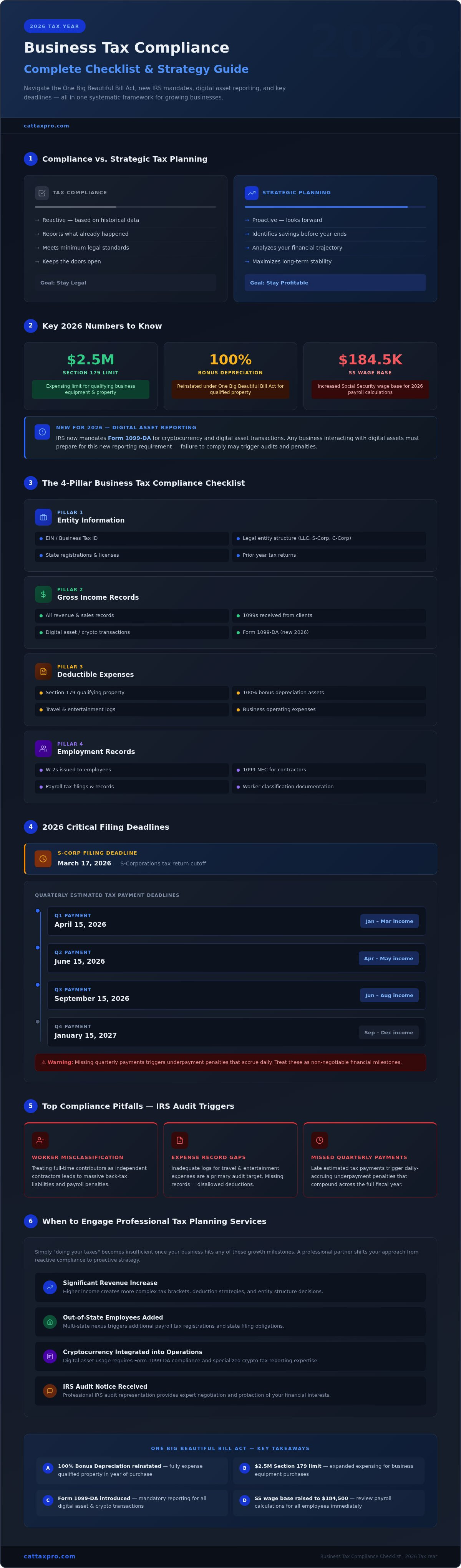
There is a fundamental difference between staying legal and staying profitable. Tax compliance is a reactive process centered on historical data; you're reporting what has already occurred to ensure you meet the minimum legal standards. Understanding the foundational structure of Corporate Tax in the United States is the first step toward transforming your financial records from a liability into a strategic asset. While compliance keeps the doors open, strategic tax planning is proactive. It involves analyzing your financial trajectory to identify saving opportunities before the year ends.
As your business scales, you'll reach a point where simply "doing your taxes" is insufficient. You need to transition into managing a total tax strategy. The triggers for professional business tax planning services usually include a significant increase in revenue, the addition of out-of-state employees, or the integration of cryptocurrency into your operations. At this stage, a professional partner acts as a strategic guide, ensuring that your tax preparation for businesses isn't just about checking boxes but about maximizing your long-term stability.
Common Compliance Pitfalls for Growing Teams
Even meticulous founders often stumble on specific areas that the IRS monitors closely in 2026. One of the most frequent errors is the misclassification of workers. Treating a full-time contributor as an independent contractor rather than an employee can lead to massive back-tax liabilities and payroll penalties. Similarly, inadequate record-keeping for travel and entertainment expenses remains a primary target for audits. If you can't produce a clear, contemporaneous log of these costs, the IRS will likely disallow the deductions entirely.
Missing quarterly estimated tax payment deadlines is another avoidable trap. For 2026, these critical milestones are:
- Q1: April 15, 2026
- Q2: June 15, 2026
- Q3: September 15, 2026
- Q4: January 15, 2027
Falling behind on these payments triggers underpayment penalties that accrue daily. By maintaining a rigorous business tax compliance checklist, you ensure these dates are treated as non-negotiable milestones in your financial calendar. This level of organization provides the peace of mind necessary to focus on your company's expansion rather than its defense.
The Essential 2026 Business Tax Compliance Checklist
Organizing your financial data shouldn't be a frantic April exercise. A robust business tax compliance checklist categorizes your company's life into four distinct pillars: Entity Information, Gross Income, Deductible Expenses, and Employment Records. This systematic approach allows you to identify missing documentation long before the filing deadlines arrive. By treating your records as a year-round asset rather than a seasonal burden, you create a transparent trail that serves as your best defense during any regulatory inquiry.
For the 2026 tax year, your records must reflect the specific changes introduced by the One Big Beautiful Bill Act. This includes tracking qualified property for the reinstated 100% bonus depreciation and preparing for the new Form 1099-DA if your business interacts with digital assets. Consulting the IRS Business Taxes Guide can help you determine which specific federal forms apply to your entity structure. However, the true secret to a stress-free season is monthly reconciliation. Every bank and credit card statement must align perfectly with your internal ledger to ensure total data integrity.
Core Documentation and Financial Records
Your general ledger is the heartbeat of your compliance efforts. It must be supported by a complete set of primary documents, including W-2s, 1099s, and K-1s from any partnerships. Maintaining a clean ledger isn't just about accuracy; it's about providing a clear narrative of your business's financial health. We recommend keeping digital copies of all receipts for at least seven years. These files should be organized by category and date, ensuring that you can produce proof of any expense within minutes if requested by an auditor. If managing this level of detail feels overwhelming, professional bookkeeping services can provide the disciplined oversight your growth requires.
Employment and Payroll Compliance
Payroll is an area where the IRS rarely shows leniency. Your checklist must include the timely filing of Form 941 for quarterly federal tax returns and Form 940 for annual unemployment taxes. Beyond the filings, you're responsible for maintaining up-to-date W-4 and I-9 forms for every member of your team. Verification of employment eligibility is a non-negotiable legal requirement that often gets overlooked during rapid hiring phases. Utilizing professional payroll administration helps you avoid the severe penalties associated with late tax deposits, ensuring your team remains paid and your business remains in good standing with both state and federal authorities.
Compliance for the Digital Age: Cryptocurrency and Virtual Assets
The IRS has intensified its scrutiny of digital assets, transforming virtual currency reporting into a non-negotiable part of your business tax compliance checklist. For the 2026 filing season, the introduction of Form 1099-DA marks a significant shift in transparency. Brokers are now mandated to report digital asset transactions directly to the government. This means the IRS will have a record of your activity before you even begin your return. Standard bookkeeping often fails in this arena because it isn't built to capture the high-velocity movement of tokens between private wallets and centralized exchanges.
Relying on generic software often leads to "basis drift," where the original purchase price of an asset is lost during transfers. This lack of data integrity makes it nearly impossible to calculate capital gains accurately. To protect your company's long-term stability, you must implement specialized accounting practices that track every digital movement. This proactive management ensures that your financial records remain audit-proof in an environment of increasing regulatory pressure. It's no longer enough to report "best guesses"; you need a documented trail for every token you hold or trade.
Tracking Cost Basis and Capital Gains
Determining your tax liability requires a meticulous record of every "taxable event," including sales, trades, and the use of crypto for business purchases. Calculating gains across a fragmented ecosystem of wallets is a technical challenge that demands professional oversight. Whether you choose First-In, First-Out (FIFO) or a Specific Identification method, the logic must be applied consistently to withstand IRS review. For the 2026 tax year, brokers are required to report cryptocurrency transactions on the new Form 1099-DA. This requirement ensures that your cost basis and sales proceeds are documented with the same rigor as traditional stock trades, providing a sense of order for your digital portfolio.
Virtual Currency as Business Payment
Using cryptocurrency to settle vendor invoices or pay employee bonuses introduces a dual layer of compliance. Because the IRS classifies digital currency as property rather than legal tender, every payment is a disposal of an asset. You must record the fair market value in U.S. dollars at the time of the transfer to satisfy both payroll and income reporting requirements. This valuation is critical for your business tax compliance checklist, as it determines the exact deduction your business can claim. Integrating Cryptocurrency Accounting Services into your workflow allows you to manage these modern digital landscapes without sacrificing the classic accounting principles that keep your business secure.
Strengthening Your Internal Controls: Bookkeeping and QuickBooks
Bookkeeping serves as the engine room of your entire tax infrastructure. While a business tax compliance checklist provides the essential roadmap, your ledger is the vehicle that carries you through the fiscal year. Moving away from disorganized manual spreadsheets to a professional management system is a critical step for any growing entity. This transition ensures that every transaction is categorized correctly from the moment it occurs, preventing the common data scramble that plagues many businesses during the first quarter. Monthly financial statements act as an essential early warning system, allowing you to identify compliance anomalies or unexpected expense spikes before they solidify into permanent tax liabilities. By reviewing your Profit and Loss statements and Balance Sheets regularly, you maintain a sense of order that naturally discourages sloppy reporting.
The discipline of maintaining a professional ledger does more than just simplify tax season; it provides a sense of security and peace of mind. When your internal controls are strong, you aren't just guessing at your financial health; you're operating from a foundation of verified facts. This methodical approach to record-keeping is what separates stable, audit-proof businesses from those that live in a state of constant regulatory anxiety. In an era where the IRS is increasing its scrutiny of small business operations, having a clean, well-mapped financial ecosystem is your most effective defense.
Optimizing Your QuickBooks Ecosystem
A generic software setup often creates more confusion than clarity. To ensure data integrity, your QuickBooks environment must be tailored to your specific industry requirements. This shift is especially relevant as the industry moves toward cloud accounting software, reflecting a broader trend away from traditional desktop products. Start with a customized Chart of Accounts that defines income and expense categories mirroring your actual operations. This prevents the misclassification of expenses that often leads to disallowed deductions during an audit. Next, automate your bank feeds to increase efficiency, but maintain a disciplined schedule for manual oversight to verify each transaction. Finally, implement class tracking to segment your data by department, project, or location. This granular analysis allows you to see exactly where your capital is deployed, making your business tax compliance checklist more effective by providing the specific documentation required for specialized business credits.
The Role of Professional Bookkeeping Services
There is a vast difference between DIY bookkeeping and professional financial oversight. Software alone cannot replace the seasoned judgment required to navigate complex tax law. Many business owners fall into the "Garbage In, Garbage Out" trap, where unmanaged software produces reports that are technically balanced but factually incorrect. Professional bookkeeping services reduce the risk of audit-triggering errors by ensuring your books are reconciled and tax-ready every month. If your accounts have been neglected or your ledger is currently a source of anxiety, a professional QuickBooks cleanup can restore order and provide a clean slate for future growth. Our firm acts as a strategic guide in this process, ensuring your internal controls are strong enough to withstand high-pressure negotiations with regulatory bodies. If you're ready to secure your financial foundation, our team provides expert QuickBooks setup and training to empower your internal staff and ensure long-term stability.
Selecting the Right Business Tax Planning Services for Growth
A business tax compliance checklist acts as your foundational map, yet navigating the complexities of the 2026 fiscal environment requires more than just a list of forms. There is a profound difference between a generic tax filer who merely records history and a strategic partner who helps you write it. While a filer ensures you meet the minimum requirements, a strategic partner actively seeks out opportunities within the One Big Beautiful Bill Act, such as the increased Section 179 expensing limit of $2.5 million. These specialized tax planning services are designed to pay for themselves by identifying high-value credits and deductions that reactive preparation often misses.
When evaluating a potential partner, prioritize those who offer comprehensive IRS audit representation. This service is a critical differentiator that provides an emotional appeal of security and peace of mind. In the event of an inquiry, you need a meticulous expert who serves as a steadfast defender of your financial interests. This professional should be equally comfortable managing routine administrative tasks as they are defending your positions before regulatory bodies. Ensure your chosen firm has verified credentials and specialized experience in modern sectors, particularly if your growth strategy involves the digital asset reporting mandates discussed in previous sections.
What to Look for in a Tax Strategy Partner
Credential verification is the first step in selecting an expert who can safeguard your company's future. You should seek licensed professionals, such as CPAs or Enrolled Agents, who possess a deep understanding of both traditional fiscal practices and modern digital landscapes. A strategic partner must demonstrate a track record of successful IRS audit defense and resolution, proving they can protect your assets under pressure. This expertise is especially vital for businesses operating in high-scrutiny areas like cryptocurrency, where specialized accounting is required to maintain a foundation in classic accounting principles while embracing new financial technologies.
Next Steps: From Checklist to Compliance
The transition from a manual business tax compliance checklist to a sophisticated tax strategy begins with a professional consultation. Preparing for this review involves consolidating your financial records, from your QuickBooks ledger to your payroll tax filings. This organized approach allows a strategic guide to assess your current standing and map out a protective framework for the coming year. At Catherine Accounting & Tax Services LLC, we provide the one-stop convenience of combining payroll, bookkeeping, and tax planning to create a complete and well-mapped financial ecosystem. Our commitment to your long-term stability ensures that every possible financial contingency has been considered. To begin this process, we invite you to schedule a consultation for business tax planning services and experience the confidence of expert oversight.
Securing Your Competitive Advantage Through Tax Discipline
Mastering the 2026 fiscal year requires a deliberate shift from seasonal panic to year-round strategic management. By implementing a rigorous business tax compliance checklist, you've established the internal controls necessary to navigate the complexities of Form 1099-DA and the latest depreciation rules under the One Big Beautiful Bill Act. This disciplined approach does more than just satisfy regulatory bodies; it provides the data integrity and peace of mind required for sustainable business expansion. When your financial records are audit-proof, you're free to focus your energy on growth rather than defense.
True financial stability comes from partnering with an expert who serves as your strategic guide and steadfast defender. Our firm provides specialized crypto tax accounting, certified QuickBooks training and setup, and comprehensive IRS audit representation to protect your long-term interests. We handle the technical nuances of your ledger so you can maintain a sense of order in a complex regulatory landscape. We invite you to Secure Your Business Future with Professional Tax Planning Services today. Your commitment to financial clarity is the most powerful tool you have for building a resilient and prosperous enterprise.
Frequently Asked Questions
What is the most important item on a business tax compliance checklist?
The most critical component of a business tax compliance checklist is the maintenance of accurate, contemporaneous financial records. Without a verifiable trail of income and expenses, every other compliance effort lacks a stable foundation. This discipline ensures that your tax filings are based on reality rather than estimates, which significantly reduces your risk profile during a regulatory review or a high-pressure audit.
How often should a small business review its tax compliance status?
You should review your tax compliance status on a monthly basis through a formal reconciliation process. Waiting until the end of the fiscal year creates a high-pressure environment where errors are more likely to occur. Regular monthly reviews allow you to identify missing documentation, track quarterly estimated payments, and adjust your strategy in response to real-time revenue fluctuations and evolving regulations.
Does my business need a professional tax planner if I use QuickBooks?
Yes, because software is a tool for data entry rather than a strategic advisor. While QuickBooks is excellent for organizing transactions, it cannot interpret complex tax laws or identify industry-specific saving opportunities. A professional ensures your software is configured correctly and provides the expert oversight necessary to transform your raw financial data into an audit-proof growth strategy.
What happens if my business fails an IRS tax audit?
If your business fails an IRS audit, the agency will issue a notice of deficiency detailing the additional taxes, interest, and penalties you owe. This situation requires immediate professional intervention to navigate the appeals process or negotiate a settlement. Having a steadfast defender for IRS audit representation is vital to protecting your company's assets and restoring your long-term financial stability.
Are cryptocurrency transactions for business purposes taxable in 2026?
Cryptocurrency transactions remain fully taxable in 2026, as the IRS continues to treat digital assets as property. Every sale, trade, or business payment made with virtual currency is a taxable event that must be reported with its corresponding cost basis. The implementation of Form 1099-DA means the IRS now receives direct reports of these transactions, making precise digital asset accounting essential.
How does professional payroll administration improve tax compliance?
Professional payroll administration improves compliance by automating the calculation and deposit of federal and state payroll taxes. Late or inaccurate payroll tax deposits are a primary trigger for aggressive IRS collection actions and severe financial penalties. By delegating this function, you ensure that Form 941 and Form 940 are filed correctly and that your business remains in good standing with all authorities.
What is the difference between a tax preparer and a tax planning specialist?
A tax preparer focuses on the reactive task of filing historical data, while a tax planning specialist focuses on proactive wealth preservation. Planning involves analyzing your business structure to minimize your overall tax burden through legal credits and strategic incentives. Integrating these proactive insights into your business tax compliance checklist transforms your tax obligation from a seasonal stressor into a controlled business expense.
Can I claim a home office deduction for my business in 2026?
You can claim a home office deduction in 2026 if you use a specific portion of your home exclusively and regularly for your business. The space must serve as your principal place of business or a place where you meet with clients in the normal course of operations. You may choose between the simplified method or the regular method based on which provides the most significant benefit.


