
With a record 3.23 million new business applications filed in the first half of 2026, the IRS has intensified its focus on small business compliance and digital asset reporting. For many entrepreneurs, the complexity of LLC tax filing requirements often leads to a paralyzing fear of missing a deadline or triggering an audit. You likely started your business for freedom, not to become an unpaid administrator drowning in forms like Schedule C or Form 1065. It's frustrating to feel like you're overpaying in self-employment taxes simply because you don't understand your "disregarded entity" status or how to track modern cryptocurrency transactions correctly.
We're here to replace that anxiety with a structured roadmap for financial stability. This guide provides the clarity you need to master your federal obligations while identifying strategic opportunities to protect your bottom line. You'll discover how to leverage the permanent 20% QBI deduction, maximize the restored 100% bonus depreciation, and manage the updated $40,000 SALT deduction limit. From precise filing deadlines to advanced savings strategies, we'll ensure you move through the 2026 tax season with the confidence of a seasoned professional and the peace of mind that comes from total compliance.
Key Takeaways
- Understanding your entity classification—whether as a disregarded entity or a partnership—is the foundational step in mastering LLC tax filing requirements and avoiding costly administrative errors.
- Ensure timely compliance by marking critical 2026 deadlines, including March 16 for multi-member LLCs and April 15 for single-member entities and C-Corps.
- Discover strategic saving opportunities by maximizing the permanent 20% Qualified Business Income (QBI) deduction and exploring the self-employment tax advantages of an S-Corp election.
- Maintain regulatory order in the digital landscape by implementing precise cost basis tracking for cryptocurrency assets and preparing for new Form 1099-DA reporting obligations.
- Secure long-term stability and audit protection by establishing a meticulous bookkeeping foundation through QuickBooks and professional audit representation.
Understanding LLC Tax Classifications: How the IRS Views Your Business
The IRS does not recognize a Limited Liability Company as a distinct taxing category. Instead, it treats the entity based on the number of owners and specific elections made by the business. This flexibility is a primary advantage of the structure, but it also creates the first hurdle in meeting LLC tax filing requirements. Your classification determines which forms you submit, when they are due, and how much of your profit remains in your pocket. It's a strategic framework that requires careful selection to ensure you aren't overpaying.
Single-Member LLCs and Pass-Through Taxation
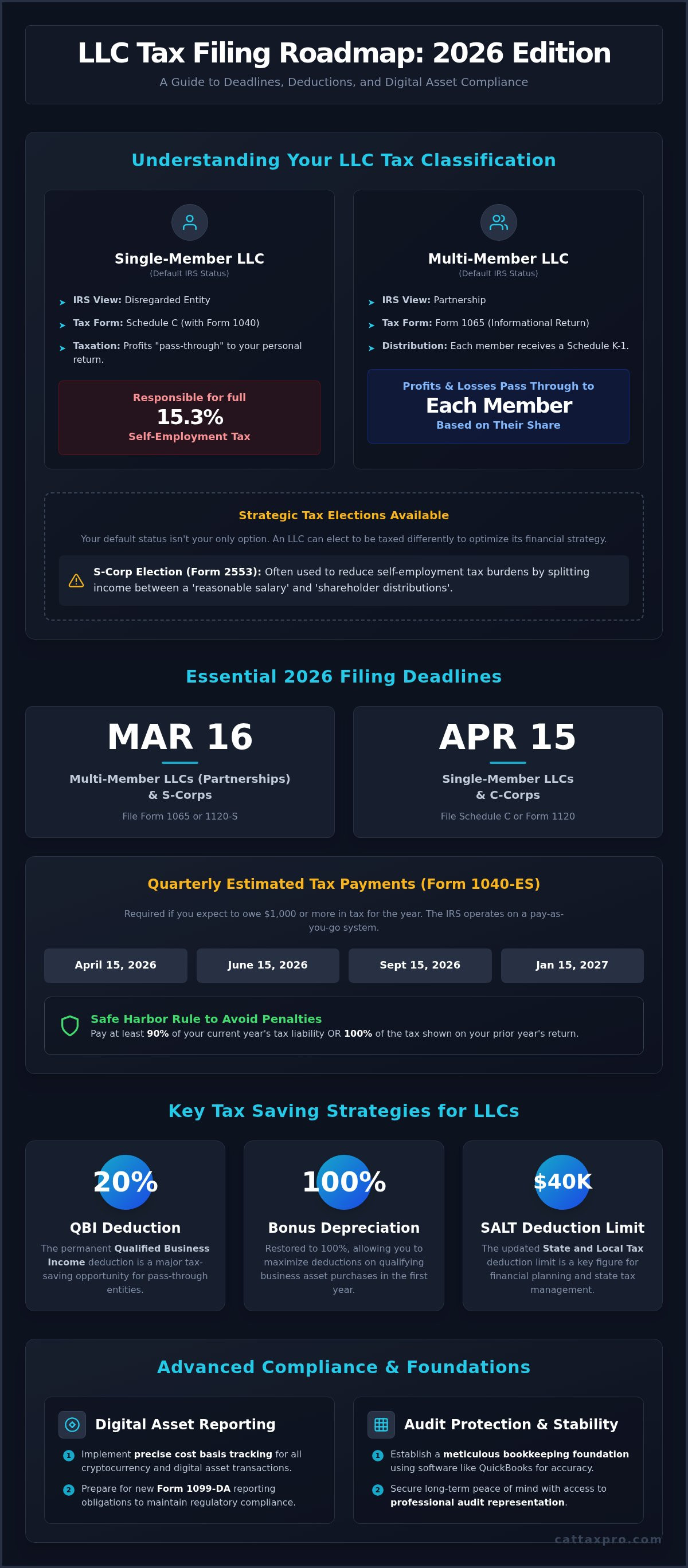
If you're the sole owner of your business, the IRS views your entity as a disregarded entity by default. This doesn't mean your business is ignored; rather, the tax obligations pass through the entity directly to your personal return. You'll report all business income and expenses on Schedule C of your Form 1040. This setup is highly efficient for new entrepreneurs because it avoids the complexity of corporate filings. However, it requires a disciplined approach to self-employment taxes. Since you're both the employer and the employee, you're responsible for the full 15.3% Social Security and Medicare contribution on your net earnings. Many owners find peace of mind in this simplicity, but they must remain vigilant about quarterly estimated payments to avoid penalties.
Multi-Member LLCs: The Partnership Framework
When an LLC has two or more members, the IRS automatically classifies it as a partnership for tax purposes. This shift introduces the requirement for an informational return known as Form 1065. While the partnership itself doesn't pay income tax, it must report total revenue and deductions to the IRS. Each member then receives a Schedule K-1, which details their specific share of the profits or losses. Accurately managing these filings requires meticulous tracking of member basis and capital accounts. This ensures that distributions are handled correctly and that each partner's tax liability reflects their actual economic interest in the firm. Without precise bookkeeping, multi-member entities face significant audit risks during the 2026 season.
Your default status isn't your only option. You can use Form 8832 to elect to be treated as a C-Corporation, or use Form 2553 to request S-Corporation status. These elections are powerful tools for saving money. For example, an S-Corp election often helps high-earning owners reduce their self-employment tax burden by splitting income between a reasonable salary and shareholder distributions. Choosing the right path is a strategic decision that aligns your LLC tax filing requirements with your long-term financial stability and growth objectives.
Essential LLC Tax Filing Deadlines and Forms for 2026
Timing is the cornerstone of financial discipline. For the 2026 tax year, the calendar presents specific nuances that every business owner must track to maintain standing with the IRS. Meeting your LLC tax filing requirements starts with a rigorous commitment to these dates. Multi-member LLCs filing as partnerships and entities that have elected S-Corp status face a deadline of March 16, 2026, because the traditional March 15 date falls on a Sunday. Single-member LLCs and those taxed as C-Corps must submit their filings by April 15, 2026. If you employ staff, you'll also manage Form 941 for quarterly payroll reporting and Form 940 for annual unemployment taxes. Missing these milestones isn't just an administrative lapse; it's a financial risk that invites unnecessary penalties.
Quarterly Estimated Taxes: Avoiding Underpayment Penalties
The IRS operates on a pay-as-you-go system. If you expect to owe $1,000 or more in taxes for the year, you must submit quarterly estimated payments using Form 1040-ES. For 2026, these payments are due on April 15, June 15, September 15, and January 15 of 2027. To protect yourself from underpayment penalties, you should adhere to safe harbor rules. This generally means paying at least 90% of your current year's tax liability or 100% of the tax shown on your prior year's return. Professional QuickBooks setup and training simplifies quarterly calculations by automating the categorization of income and expenses in real time. Maintaining this level of organization ensures you aren't blindsided by a large, unexpected bill at year-end.
Annual Information Returns and Schedules
Accuracy in your annual return depends on the correct use of supplemental schedules. Single-member owners must utilize Schedule SE to calculate self-employment tax, which covers your contributions to Social Security and Medicare. When navigating the IRS guidelines on LLC tax classification, it's clear that the timing of your election is as vital as the election itself. If you intend to change how your entity is taxed, Form 8832 must be filed within specific windows to be effective for the current year. Beyond the filing itself, your record-keeping practices must be beyond reproach. We recommend keeping all tax-related documents for at least seven years. This provides a robust defense in the event of an inquiry and ensures you have a complete financial history for your business.
While federal obligations are uniform, don't overlook state-level mandates. Many jurisdictions require annual reports or separate franchise taxes that don't always align with federal dates. If you're overwhelmed by these overlapping timelines, professional tax preparation for businesses ensures you never miss a critical deadline or leave a deduction on the table. Staying ahead of the calendar is the most effective way to protect your bottom line.
Small Business Tax Saving Strategies: A Roundup for LLC Owners
Fulfilling your mandatory LLC tax filing requirements shouldn't be viewed solely as an administrative burden. Instead, sophisticated business owners treat the tax code as a strategic playbook to unlock capital for reinvestment. By moving beyond basic compliance, you can implement frameworks that protect your profit margins and enhance your long-term financial stability. The 2026 tax landscape offers several permanent advantages that reward proactive planning and meticulous record-keeping.
The Section 199A Qualified Business Income (QBI) deduction remains a cornerstone of LLC tax saving strategies in 2026. This provision allows eligible pass-through entities to deduct up to 20% of their qualified business income from their federal tax liability. It's a powerful tool that directly lowers your effective tax rate without requiring you to increase your business expenses. Additionally, leveraging retirement plan contributions provides an immediate tax shield while securing your personal future. Under the SECURE Act 2.0, 2026 introduces "Starter 401(k)" plans with a $6,000 deferral limit, while individuals aged 60 to 63 can benefit from an increased catch-up contribution limit of $11,250. These contributions reduce your taxable income dollar-for-dollar, providing a dual benefit of current savings and future growth.
Deduction Optimization for the Modern Business
Maximizing your deductions requires a deep understanding of current IRS rules for travel, meals, and equipment. For 2026, the 100% first-year bonus depreciation has been restored and made permanent. This allows your LLC to deduct the full cost of qualifying equipment and technology in the year you place them in service, rather than spreading the deduction over several years. You should also evaluate your home office setup; choosing between the simplified square-footage method and the actual expense method can result in significant variations in your total write-off. Professional bookkeeping services identify missed deductions by ensuring every eligible transaction is captured and categorized with surgical precision. This level of detail is your best defense against overpayment.
Strategic Entity Elections
Your default tax status isn't always the most cost-effective choice as your revenue grows. Many disregarded entities reach a threshold where an S-Corp election becomes financially superior. By electing S-Corp status, you can split your income between a "reasonable salary" and shareholder distributions. Since distributions aren't subject to the 15.3% self-employment tax, this strategy can save you thousands of dollars annually. However, the IRS maintains strict scrutiny over what constitutes a reasonable salary, making professional guidance essential to avoid audit risks. While C-Corp elections are less common for small LLCs, the stability of corporate tax rates may offer advantages for businesses planning to retain large amounts of earnings for future expansion. Aligning your entity structure with your 2026 LLC tax filing requirements ensures your business remains lean and competitive.
Advanced Compliance: Crypto Assets and Multi-State LLCs
Modern entrepreneurship often transcends physical borders and traditional currencies. While this expansion offers unprecedented growth, it significantly complicates your LLC tax filing requirements. The IRS has prioritized the digital economy for the 2026 season, introducing more rigorous reporting standards for digital assets and international holdings. Maintaining compliance in this environment requires a transition from basic record-keeping to advanced financial management that accounts for every digital and geographic footprint.
Cryptocurrency Accounting for Business
The introduction of IRS Form 1099-DA has fundamentally changed the digital asset landscape for small businesses. If your LLC holds, trades, or accepts Bitcoin or Ethereum, you must maintain precise cost basis tracking for every transaction. The IRS distinguishes between crypto received as business income, which is taxed at ordinary rates, and crypto held as an investment, which triggers capital gains reporting. Reconciling high-volume portfolios across multiple exchanges is a complex task that often leads to reporting discrepancies. Specialized cryptocurrency accounting ensures that every digital movement is documented with surgical precision, preventing the red flags that lead to intrusive IRS inquiries.
Multi-State Operations and Sales Tax
Operating an online LLC doesn't exempt you from state-level obligations outside your home jurisdiction. You must monitor economic nexus rules, which establish filing requirements based on your revenue or transaction volume within a specific state. If your business crosses these thresholds, you're responsible for collecting sales tax and filing state income tax returns in those jurisdictions. Proper apportionment of income ensures you only pay what's legally required in each state, protecting you from the risk of double taxation. International LLCs face additional scrutiny through the Report of Foreign Bank and Financial Accounts (FBAR) if their overseas holdings exceed $10,000 at any time during the year.
Managing these sophisticated requirements demands a partner who understands the intersection of traditional tax law and modern financial technology. Our cryptocurrency accounting services provide the technical expertise needed to secure your digital assets and ensure total multi-state compliance. Don't let regulatory complexity stall your business expansion or compromise your financial stability.
Professional Defense: Audit Representation and Expert Support
Even when you've meticulously followed every one of your LLC tax filing requirements, the IRS may still request a review of your financial records. An audit notice isn't an indictment; it's a procedural event that requires a disciplined and structured response. Many business owners mistakenly rely on basic software support, but these digital tools lack the legal standing to represent you before a revenue agent. Licensed IRS audit representation provides a protective barrier between your business and the government, ensuring that your rights are defended and your financial interests are prioritized. This level of advocacy is essential for maintaining peace of mind in a high-stakes regulatory environment.
The Role of Audit Representation
By executing Form 2848, you grant your tax professional the Power of Attorney to act as your steadfast defender. This legal authorization allows us to manage all correspondence and handle high-pressure negotiations on your behalf. You won't have to face an IRS agent alone or worry about saying the wrong thing. If your business is struggling with back-tax issues or disputes, we can negotiate offers in compromise or structured installment agreements that protect your long-term stability. The first 30 days after receiving an IRS letter are the most critical. A swift, professional response during this window prevents the escalation of penalties and demonstrates to the IRS that your business is committed to order and resolution.
Building a Scalable Financial Foundation
True security isn't found in reactive filing; it's built through an "audit-proof" bookkeeping method. We utilize QuickBooks to create a transparent, real-time record of every transaction, ensuring your documentation is beyond reproach. This approach integrates your payroll, bookkeeping, and tax filings to provide 360-degree visibility into your financial health. When your records are organized systematically, you can easily justify deductions for equipment expensing, home office use, or complex digital asset transactions. This organization serves as your primary defense against audit risks and ensures that your annual filings are accurate and defensible.
Year-round tax planning is a superior strategy compared to once-a-year filing. It allows for tactical adjustments that align with your LLC tax filing requirements while identifying savings opportunities before the tax year ends. By treating your finances as a complete and well-mapped ecosystem, you move from a position of uncertainty to one of professional authority. Our firm functions as your strategic guide, handling the routine administrative tasks and the high-pressure negotiations so you can focus on growing your business. Secure your business's future with Catherine Accounting's professional tax services.
Securing Your Business Future in 2026
Mastering your LLC tax filing requirements is the first step toward long-term financial stability. By correctly identifying your entity classification and adhering to the 2026 deadlines, you protect your business from unnecessary penalties and audit risks. However, true success lies in transforming these administrative obligations into strategic opportunities for growth. Whether you're maximizing the 20% QBI deduction or navigating the complexities of new digital asset reporting, a proactive approach ensures your bottom line remains resilient.
You don't have to manage these high-stakes requirements alone. Our firm provides specialized cryptocurrency tax support and certified QuickBooks setup and training to streamline your financial ecosystem. If the IRS ever questions your filings, our expert IRS audit representation serves as your steadfast defense. We are committed to providing the order and security your business deserves. Schedule a consultation with Catherine Accounting & Tax Services LLC for expert LLC tax filing support. Take control of your financial destiny today and build a foundation that lasts.
Frequently Asked Questions
What is the difference between a single-member and multi-member LLC for taxes?
The primary difference lies in the default tax classification and the forms required for filing. Single-member LLCs are treated as disregarded entities, meaning the owner reports business activity on their personal Schedule C. Multi-member LLCs are classified as partnerships, which necessitates filing an informational Form 1065. While the single-member structure offers administrative simplicity, the multi-member framework requires managing member capital accounts and distributing Schedule K-1s to each partner for their individual returns.
Do I need a separate EIN for my LLC tax filing?
Most business owners should obtain a separate Employer Identification Number (EIN) to maintain professional separation between personal and business finances. While the IRS allows some single-member entities to use a Social Security number, an EIN is mandatory if you plan to hire employees, open a business bank account, or elect S-Corp status. This unique identifier is a core component of your LLC tax filing requirements and helps secure your business identity against potential fraud.
How much should I set aside for LLC taxes in 2026?
You should generally set aside 25% to 30% of your net business income to cover federal and state liabilities. This estimate accounts for both your personal income tax rate and the 15.3% self-employment tax. Since LLC owners are responsible for both the employer and employee portions of Social Security and Medicare, maintaining a disciplined tax reserve prevents cash flow crises. It's vital to adjust this percentage based on your specific tax bracket and any available deductions like the 20% QBI deduction.
Can I file my LLC taxes on my personal 1040 return?
You can file your business income directly on your personal Form 1040 if you're a single-member LLC. In this case, your business activity is documented on Schedule C. For multi-member LLCs or those taxed as corporations, the business must file its own distinct return first. The profits or losses then flow through to your personal return via Schedule K-1, ensuring that the entity's financial activity is properly reconciled before it impacts your individual tax liability.
What happens if I miss the LLC tax filing deadline?
Missing a filing deadline triggers immediate failure-to-file and failure-to-pay penalties plus accrued interest. For partnerships and S-Corps, the penalty is often assessed per month and per member, which can quickly erode your capital. If you realize a deadline has passed, filing as soon as possible and requesting a penalty abatement for reasonable cause is the most effective way to resolve the dispute. Taking swift action demonstrates a commitment to compliance and can help protect your long-term standing with the IRS.
How does the IRS track cryptocurrency for LLCs?
The IRS tracks cryptocurrency transactions through mandatory reporting from digital asset brokers on the new Form 1099-DA. Your LLC must maintain a detailed ledger of every trade, including the date, fair market value, and cost basis in U.S. dollars. Because the IRS uses sophisticated data-matching technology to identify unreported digital asset income, specialized cryptocurrency accounting is necessary. This ensure your records align perfectly with the information reported by exchanges and prevents unnecessary audit triggers.
Is an S-Corp election right for my small LLC?
An S-Corp election is typically beneficial once your LLC generates enough profit to pay yourself a reasonable salary while still having excess distributions. This strategy allows you to avoid the 15.3% self-employment tax on the distribution portion of your income. However, the added administrative costs of payroll and separate corporate tax filings mean this election is best suited for businesses with consistent profit margins. A careful analysis of your projected earnings is required to determine if the tax savings outweigh the additional complexity.
What is a disregarded entity and how does it affect my filing?
A disregarded entity is a business that the IRS ignores for federal income tax purposes, treating the owner and the business as a single taxpayer. This classification streamlines your LLC tax filing requirements by allowing you to report all financial activity on your personal tax return. While it simplifies the filing process, it doesn't change your legal liability protection or your obligation to pay self-employment taxes. It remains a foundational structure for solo entrepreneurs seeking to maintain order without the burden of corporate tax returns.


