
Could a single oversight in your reasonable salary calculation trigger an IRS audit that jeopardizes your business assets? Many S Corp owners operate under a constant cloud of anxiety, fearing that the complexity of Form 1120-S and Schedule K-1 will eventually lead to a costly regulatory confrontation. You've likely felt the strain of managing payroll while trying to ensure every deduction is defensible. It's a high-stakes balancing act where the margin for error is razor-thin. Professional s corp tax preparation services offer more than just filing; they provide a disciplined framework for long-term financial security.
You deserve a tax strategy that works as hard as you do, turning compliance into a competitive advantage rather than a source of stress. This comprehensive 2026 guide will teach you how to master S Corp requirements and minimize your tax liability through meticulous planning. We'll examine the seamless integration of payroll and bookkeeping, the nuances of asset protection, and the specific steps needed to maintain a robust audit shield. By the end of this article, you'll have a clear roadmap for protecting your business and achieving full IRS compliance with confidence.
Key Takeaways
- Understand how the S Corp pass-through structure eliminates double taxation while requiring distinct filing procedures compared to C Corps or sole proprietorships.
- Master the essential components of Form 1120-S and Schedule K-1 to ensure accurate reporting of shareholder income and deductions.
- Learn why professional s corp tax preparation services prioritize the "reasonable salary" requirement to mitigate the risk of IRS audits and payroll tax penalties.
- Identify high-value tax planning opportunities, including Section 199A QBI deductions and often-overlooked expenses like home office and equipment costs.
- Discover the protective benefits of professional audit representation and how integrated bookkeeping creates a robust defense for your business assets.
Understanding S Corp Tax Preparation and the Pass-Through Advantage
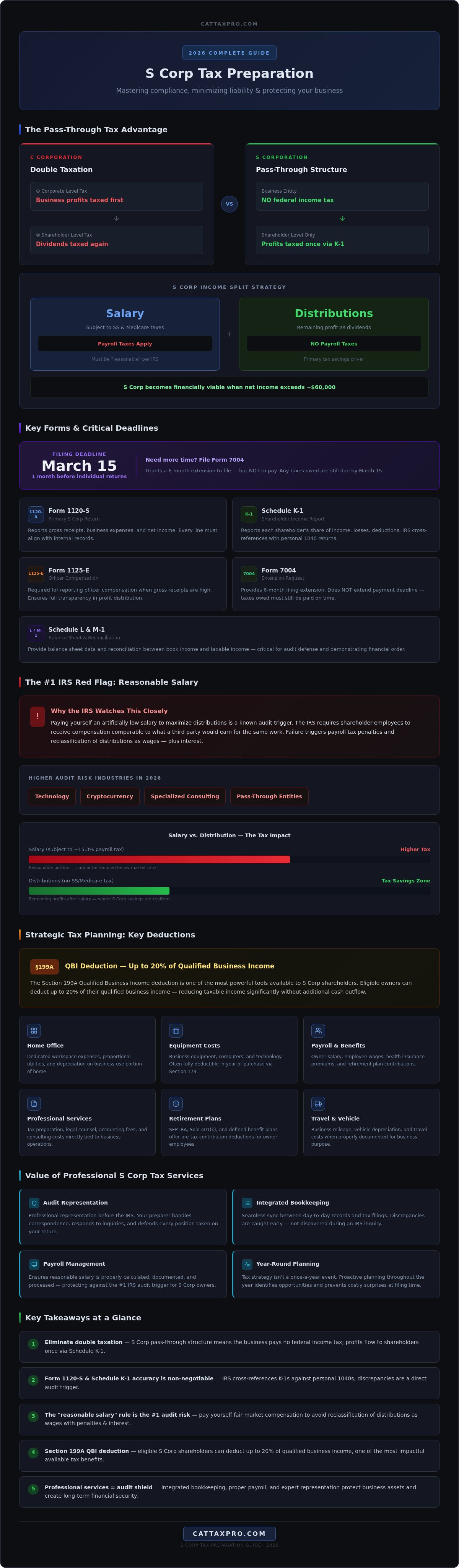
Choosing the S Corporation election is a strategic move to protect your business income from excessive tax exposure. Unlike a C Corp, which faces taxation at both the entity and shareholder levels, an S Corp functions as a pass-through entity. This means the business itself generally pays no federal income tax. Instead, the responsibility for s corp tax preparation services involves documenting how profits flow directly to the shareholders. You'll use Form 1120-S to report the total business activity, including every deduction, credit, and net gain. This structure is fundamentally different from a sole proprietorship, where the owner pays self-employment tax on the entire net income. By using an S Corp, you only pay those taxes on the salary portion of your earnings, which can lead to significant savings in the 2026 tax year.
The S Corp election remains a powerful tool because it allows for a sophisticated division of income. While the IRS requires you to pay yourself a reasonable salary, the remaining profits can be distributed as dividends. These distributions are not subject to Social Security or Medicare taxes. This distinction is the primary driver for many small businesses choosing this path. It provides a sense of order and financial efficiency that simpler structures cannot match. However, the complexity of managing these two distinct income streams requires a disciplined approach to bookkeeping and payroll management to avoid regulatory scrutiny.
The Mechanics of Pass-Through Taxation
Profits move from the business to the individual via Schedule K-1. This document specifies your exact share of the company's financial results, which you then report on your personal return. By bypassing the corporate tax rate, you avoid the double taxation trap that often drains the resources of traditional corporations. It's a matter of discipline and professional order to maintain separate bank accounts and document corporate minutes to ensure the IRS respects your tax status.
Who Benefits Most from S Corp Tax Services?
The transition to an S Corp usually becomes financially viable once net income exceeds certain thresholds, often around $60,000. In the 2026 tax environment, staying compliant is more vital than ever as the IRS increases its focus on pass-through entities. High-growth sectors like technology, cryptocurrency, and specialized consulting often face higher audit risks. These industries require the comprehensive reliability of professional s corp tax preparation services to defend their long-term stability and ensure every deduction is defensible.
Key Components of S Corp Tax Compliance: Forms and Deadlines
Compliance isn't just about filing; it's about accuracy and timing. The cornerstone of this process is Form 1120-S. This primary return documents the corporation's gross receipts, business expenses, and net income. While the corporation doesn't pay income tax directly, it must report these figures with absolute precision to avoid triggering an inquiry. This is where professional s corp tax preparation services become indispensable. They ensure that every line item on the 1120-S aligns with your internal records, providing a seamless transition to the individual shareholder level.
The bridge between the corporation and its owners is Schedule K-1. This document reports each shareholder's specific share of income, losses, deductions, and credits. It's a high-stakes document because the IRS uses it to cross-reference personal tax returns. Discrepancies between a K-1 and an individual 1040 are a frequent source of red flags. Maintaining professional order here is the only way to safeguard your personal financial standing.
Timing is equally critical. March 15 is the definitive deadline for S Corp filings. This date is exactly one month earlier than the individual filing deadline, giving shareholders time to receive their K-1s and incorporate them into their personal returns. If you can't meet this deadline, filing Form 7004 provides a six-month reprieve. However, an extension to file is not an extension to pay any taxes owed. Maintaining a strict calendar is the best way to preserve your peace of mind and avoid late-filing penalties.
Essential Forms Beyond the 1120-S
Accuracy requires looking beyond the main return. Form 1125-E is necessary for reporting officer compensation if gross receipts are high. This ensures total transparency in how profits are distributed. Additionally, Schedule L and M-1 allow you to reconcile your book income with your tax return income, showing the IRS exactly why figures might differ. The most common error in S Corp compliance is failing to track shareholder basis. Without accurate basis records, you risk paying taxes on distributions that should be tax-free. Our team provides the specialized bookkeeping and tax support needed to keep these records flawless.
Reporting Digital Assets and Cryptocurrency
The 2026 tax landscape introduces stricter requirements for virtual currencies. S Corps holding digital assets must now navigate the 1099-DA reporting rules. These forms provide the IRS with detailed transaction data, making it impossible to overlook crypto trading gains or losses. Reconciling these assets within a business structure requires meticulous tracking of every trade and distribution. Digital asset valuations at the time of distribution directly impact the shareholder's adjusted basis, requiring precise cost-basis tracking for 2026 compliance.
Avoiding the #1 IRS Red Flag: Reasonable Salary and Payroll
The IRS maintains a vigilant watch over S Corp distributions to ensure owners don't circumvent payroll taxes. If you provide significant services to your corporation, you must receive compensation that the IRS deems "reasonable." Failure to do so is the most frequent catalyst for an audit. The goal of sophisticated s corp tax preparation services is to find the precise equilibrium between a defensible salary and tax-advantaged distributions. This balance allows you to enjoy the benefits of the pass-through structure while maintaining a secure standing with regulatory bodies.
Underpayment of payroll taxes is easily identified by the IRS when they compare your 1120-S distributions to your W-2 wages. If your business shows high profits but the officer's salary is negligible, it creates an immediate red flag. Professional payroll administration ensures that your tax withholdings and employer contributions are handled with discipline throughout the year. This proactive management prevents the anxiety of a massive year-end tax bill or an unexpected IRS notice. It's a matter of creating a stable foundation for your business's growth.
Determining "Reasonable" Compensation
The IRS evaluates reasonableness based on several objective factors. They consider your specific duties, your level of experience, and the time you devote to the business. Industry benchmarks for similar roles in your geographic area are also essential data points. You must document your salary justification to survive a potential inquiry. A common mistake is taking a zero salary while receiving large distributions; this practice is a direct invitation for an audit. By establishing a salary based on market data, you create a robust defense for your tax strategy.
Integrating Payroll with Year-End Tax Prep
Your quarterly payroll filings must align perfectly with your final 1120-S return. Any discrepancy between these reports can trigger an automated IRS flag. Managing federal and state unemployment tax obligations is another layer of complexity that requires meticulous attention. Utilizing professional QuickBooks setup and training ensures that your salary tracking is automated and accurate. This integration allows for a seamless transition from daily operations to final tax filing. When your payroll and tax preparation are synchronized, you gain a sense of order that protects your long-term stability. Our team provides the specialized s corp tax preparation services and payroll support needed to navigate these high-stakes requirements with confidence.
Strategic Tax Planning: Maximizing S Corp Deductions
High-quality s corp tax preparation services function as both a defensive shield and a growth engine for your business. Rather than viewing the filing deadline as a one-time event, successful owners treat tax planning as a year-round discipline. This proactive approach uncovers often-overlooked deductions such as home office expenses, business travel, and Section 179 equipment expensing. When you purchase new technology or office furniture, you can often deduct the full cost in the year of purchase rather than depreciating it over several years. This immediate deduction provides a vital cash flow advantage that supports your company's operational agility and long-term stability.
The Section 199A Qualified Business Income (QBI) deduction remains one of the most significant benefits for S Corp shareholders in 2026. It allows eligible owners to deduct up to 20% of their business income, provided they meet specific income thresholds and industry requirements. Beyond QBI, retirement planning strategies like SEP IRAs and Solo 401(k)s serve as sophisticated tools for minimizing tax liability. These contributions are made with pre-tax dollars, which lowers your taxable profit while building personal wealth. Managing these contributions requires precise coordination between your personal financial goals and the corporation's available cash flow to ensure you maximize every available credit.
Proactive Planning vs. Reactive Filing
Quarterly tax projections are essential to avoid the sting of underpayment penalties and unexpected liabilities. By reviewing your numbers every three months, you can adjust your withholdings or estimated payments to reflect your company's actual performance. Timing is also a critical factor; accelerating business expenses into the current year can significantly lower your immediate tax burden. Monthly financial statements prevent tax-season surprises by providing a clear, continuous view of your profitability and deduction eligibility. This methodical oversight ensures that you're never caught off guard by a changing financial landscape.
Modern Deductions for Digital Businesses
The modern business environment requires a specialized approach to identifying legitimate deductions. Software subscriptions, cloud infrastructure, and remote work tools are essential business expenses that must be categorized correctly to survive an audit. For those operating in the cryptocurrency space, tracking gas fees and hardware wallet costs is vital for maintaining an accurate basis and maximizing your tax position. Our team provides the business accounting and payroll support necessary to capture every digital deduction and provide s corp tax preparation services that protect your hard-earned assets.
The Value of Professional S Corp Tax Preparation Services
Professional oversight is the most effective way to eliminate the friction between your business operations and federal compliance. Relying on expert s corp tax preparation services ensures that your filings are not only accurate but also strategically aligned with current tax law. When a firm manages your returns, they act as a sophisticated filter that catches errors before they reach the IRS. This meticulous review process significantly reduces the risk of receiving costly IRS notices or penalty assessments. It provides a level of comprehensive reliability that software alone cannot replicate, transforming your tax season from a period of anxiety into a disciplined administrative routine.
Streamlining your operations requires more than just an annual filing. Integrating your bookkeeping and payroll with your tax strategy creates a unified financial ecosystem where data flows seamlessly between departments. This "one-stop" approach ensures that your year-end figures are already reconciled and ready for reporting. Additionally, professional QuickBooks setup and training empower you to maintain better internal controls. When you understand how to navigate your financial software, you gain the clarity needed to make informed decisions throughout the year. This combination of professional management and owner empowerment is the hallmark of a stable, well-defended business.
IRS Audit Defense: Protecting Your Business
An IRS audit can be a disruptive and high-stakes event for any S Corp owner. The process often involves a deep dive into officer compensation, shareholder basis, and business distributions. Professional IRS Audit Representation provides a steadfast defender who understands the nuances of tax law and negotiation. Your representative handles all correspondence and meetings with the IRS, resolving disputes without your direct involvement. This protective barrier allows you to continue running your company while an expert manages the technical defense of your tax positions.
Choosing the Right Partner for 2026
Evaluating a tax firm’s expertise is essential as the regulatory landscape for digital assets and pass-through entities becomes more complex. You need a partner who understands the specific reporting requirements for cryptocurrency and the evolving rules surrounding the Section 199A deduction. A firm that combines payroll, bookkeeping, and tax strategy offers a significant advantage in maintaining your long-term stability. This integrated approach ensures that every financial move you make is documented and defensible. If you're ready to secure your business assets and minimize your liability, Schedule a consultation for your S Corp tax preparation today and experience the peace of mind that comes with professional advocacy.
Secure Your Business Future with Strategic Tax Management
Mastering the complexities of S Corp compliance is a continuous journey that requires both technical precision and proactive planning. By establishing a defensible "reasonable salary" and maintaining meticulous basis records, you create a robust shield against regulatory scrutiny. Integrating your daily bookkeeping with specialized s corp tax preparation services ensures that every deduction is captured and every filing deadline is met with confidence. This disciplined approach transforms tax season from a source of anxiety into a strategic advantage for your company.
Our firm provides the comprehensive reliability you need to navigate the 2026 fiscal landscape. We offer national-scale support for growing businesses, specialized digital asset and crypto accounting, and certified expertise in IRS audit representation. This "one-stop" approach allows you to focus on scaling your operations while we handle the high-stakes details of your financial compliance and asset protection. We function as both your strategic guide and your steadfast defender in the face of complex regulatory requirements.
Secure Your S Corp Compliance with Professional Tax Preparation
You don't have to face the complexities of the tax code alone. With a professional partner in your corner, you can achieve the long-term stability and absolute peace of mind your business deserves.
Frequently Asked Questions
What is the deadline for filing S Corp taxes in 2026?
The filing deadline for S Corp tax returns in 2026 is March 16 because March 15 falls on a Sunday. This date applies to all calendar-year corporations filing Form 1120-S. Maintaining a disciplined schedule is essential to avoid late-filing penalties. If you need more time, you can file an extension to push the deadline to September 15, 2026. Proactive planning ensures you meet these requirements without unnecessary stress.
How much should an S Corp owner pay themselves as a reasonable salary?
A reasonable salary is determined by what a similar business would pay an outside employee for the same services. The IRS doesn't provide a specific percentage but expects you to use objective data like industry salary surveys. Professional s corp tax preparation services help you document these benchmarks to survive an audit. Balancing this W-2 income with shareholder distributions is the key to maximizing your tax efficiency while remaining compliant.
Can I file my S Corp taxes myself with software?
You can file S Corp taxes yourself using commercial software, but this approach often lacks the strategic depth required for high-stakes compliance. Software cannot replace the professional authority of an expert who understands nuanced deductions and basis tracking. Manual errors in Form 1120-S often lead to IRS inquiries that cost more than the initial price of professional preparation. Having a steadfast defender ensures your business assets remain protected throughout the year.
What is a Schedule K-1 and why is it important for S Corp shareholders?
Schedule K-1 is a tax document that reports each shareholder's specific portion of the corporation's financial activity. Since an S Corp is a pass-through entity, this form transfers the tax liability from the business to the individual. You'll use the information on your K-1 to complete your personal 1040 return. Accuracy is critical because the IRS cross-references these figures to identify discrepancies in reported income. Precise reporting maintains the integrity of your tax status.
What happens if I miss the March 15 S Corp filing deadline?
Missing the filing deadline without an extension triggers a monthly penalty for each shareholder in the corporation. These fees can accumulate quickly and create a significant financial burden for your company. If you realize you can't meet the deadline, you should file Form 7004 immediately to secure a six-month reprieve. Professional management of these dates is the best way to maintain a sense of order and security for your business operations.
Does an S Corp pay federal income tax at the corporate level?
An S Corp generally doesn't pay federal income tax at the corporate level. Instead, the company's profits and losses pass through to the shareholders, who report them on their individual tax returns. This structure avoids the double taxation trap common in traditional corporations. However, some states may still impose entity-level taxes or franchise fees that require careful planning and professional s corp tax preparation services to manage effectively while protecting your bottom line.
How do I track my shareholder basis for tax purposes?
You track shareholder basis by starting with your initial investment and adjusting it annually for business income, losses, and distributions. It's a cumulative calculation that determines the taxability of the money you take out of the company. Maintaining accurate basis records is vital because taking distributions in excess of your basis can result in unexpected capital gains taxes. Detailed bookkeeping ensures these figures remain compliant and defensible during a regulatory review or audit.
Are cryptocurrency transactions reported differently for S Corps?
Cryptocurrency transactions are reported on Form 1120-S and require meticulous tracking of the fair market value at the time of each trade or distribution. For 2026, you must also comply with new 1099-DA requirements for digital assets held within the business. These transactions impact shareholder basis just like cash distributions. Utilizing specialized accounting support ensures that your digital asset activity doesn't become a regulatory red flag. This specialized oversight provides security in an evolving financial landscape.


