

Your tax return is a high-stakes financial document, and a professional individual tax preparation checklist is your most effective strategic defense. It's common to feel a sense of anxiety as the April 15, 2026, deadline approaches, especially with the IRS introducing new complexities like Form 1099-DA for digital assets. You shouldn't have to worry that a missing document or a reporting error might lead to an intrusive audit or a smaller refund than you deserve.
We're committed to providing the order and security you need to manage your fiscal responsibilities with ease. This guide offers a comprehensive, professional-grade resource designed to ensure a seamless filing season while maximizing your legal tax savings. You'll find a clear breakdown of the necessary documentation for the 2026 tax year, including updated standard deduction limits and gig economy thresholds. By following this methodical path, you can achieve a complete, error-free return and the peace of mind that comes from total IRS compliance.
Key Takeaways
- Organize your household identification and income records to eliminate common math errors and ensure the secure delivery of your 2026 refund.
- Determine if you should claim the increased 2026 standard deduction or itemize expenses like mortgage interest to maximize your legal savings.
- Utilize a professional individual tax preparation checklist to navigate modern reporting requirements for cryptocurrency transactions and gig economy income.
- Gain a strategic advantage by learning how professional oversight reduces audit triggers compared to the limitations of standard tax software.
Why a Professional Individual Tax Preparation Checklist Matters in 2026
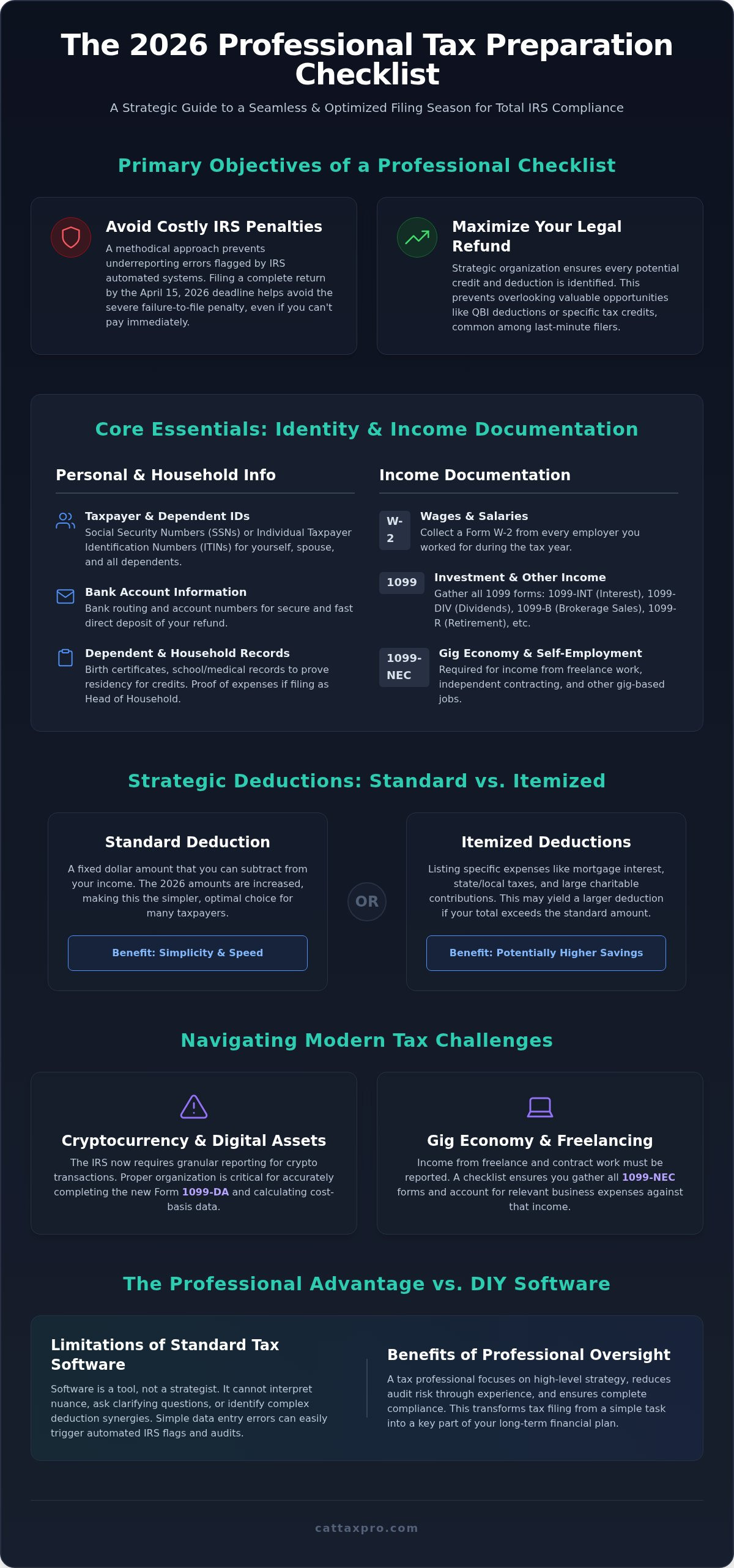
A professional individual tax preparation checklist functions as a disciplined roadmap through the complexities of the U.S. income tax system. Rather than a simple folder for receipts, this checklist provides a systematic framework for gathering essential identity, income, and expense records. The IRS increasingly relies on automated matching systems to identify discrepancies between reported income and third-party documents. Even minor math errors or omissions can trigger immediate flags, resulting in delayed refunds or unwanted correspondence. By utilizing a structured approach, you ensure that your reported figures align perfectly with the records the IRS already possesses.
As we move into the 2026 filing season, the requirements for granular reporting have intensified, particularly regarding digital assets. With the implementation of Form 1099-DA, the IRS now demands precise cost-basis data for cryptocurrency transactions. Organization doesn't just provide peace of mind; it streamlines the professional engagement. When you present a complete set of records, you allow your tax professional to focus on high-level strategy and resolution rather than administrative document chasing. This efficiency often translates into more effective planning sessions and ensures your filing is handled with the meticulous care it requires.
Avoiding IRS Penalties and Interest
Missing a single 1099-NEC or a mortgage interest statement often leads to underreporting, which the IRS identifies through its Information Returns Processing system. This discrepancy typically triggers a Notice of Deficiency, a formal letter stating that you owe additional taxes plus accrued interest and penalties. Preparation is your best defense against these costly surprises. Even if you can't pay your full tax liability immediately, filing a complete return by the April 15, 2026, deadline is critical. This action prevents the failure-to-file penalty, which is significantly more expensive than the penalty for late payment.
Maximizing Your Refund Through Strategic Organization
Strategic organization is the bridge between basic compliance and genuine tax optimization. When you provide a comprehensive individual tax preparation checklist, you ensure that every potential credit and deduction is on the table for discussion. Last-minute filers frequently overlook valuable opportunities, such as the new deduction for tips or specific Qualified Business Income (QBI) components, because they're rushing to meet the deadline. A professional preparer looks for synergies between your various financial activities. For instance, your charitable contributions might interact with your business expenses in ways that only become apparent when all data is organized and accessible. This methodical approach ensures you aren't just filing a return, but executing a plan that protects your long-term financial stability.
The Core Essentials: Identity and Income Documentation
Establishing identity and verifying income are the foundational steps of any robust individual tax preparation checklist. You must provide Social Security Numbers (SSNs) or Individual Taxpayer Identification Numbers (ITINs) for every member of your household. This includes yourself, your spouse, and all dependents. Accuracy here is non-negotiable; a single transposed digit can delay your refund for weeks or trigger an automated IRS notice. To facilitate a secure and rapid return, verify your banking information for direct deposit. This method remains the most reliable way for the IRS to issue funds, bypassing the risks of theft or loss associated with paper checks.
Wage and investment reporting requires meticulous document collection. Gather every Form W-2 from your employers; if you held multiple positions throughout 2025, ensure no statement is missing. For those with active investment portfolios, you'll need consolidated statements for interest (1099-INT) and dividends (1099-DIV). These documents provide the baseline for your taxable income and help determine which tax bracket applies to your situation. While you might follow an official IRS checklist for the basics, professional oversight ensures these figures are interpreted correctly within the broader context of your financial life.
Verifying Dependents and Household Status
Correctly identifying dependents is vital for claiming the Child Tax Credit and other family-related benefits. Maintain records such as birth certificates, school enrollment forms, or medical records to prove residency and relationship. If you're filing as Head of Household, you must document that you paid more than half the cost of keeping up a home for a qualifying person. This status offers a more favorable tax rate and a higher standard deduction of $24,150 for the 2026 tax year. For those caring for elderly or disabled adult dependents, keep records of their gross income and the specific financial support you provided to meet IRS eligibility rules.
Reporting Diverse Income Streams
Income reporting extends well beyond your primary salary and requires a disciplined approach to documentation. You must include unemployment compensation, reported on Form 1099-G, and any jury duty pay received. If you had a successful year with gaming or lotteries, gather your W-2G forms for gambling winnings. It's also prudent to keep a log of gambling losses, as these may be deductible up to the amount of your winnings if you choose to itemize. Retirement distributions also require specific attention. Whether you've taken a 401(k) withdrawal or a traditional IRA distribution, you'll receive a Form 1099-R. Correctly coding these distributions is a hallmark of individual tax preparation, ensuring you don't pay unnecessary early-withdrawal penalties or misreport non-taxable rollovers.
Strategic Deductions and Credits: Standard vs. Itemized
Choosing between the standard deduction and itemizing is a pivotal decision that dictates your final tax liability. For the 2026 tax year, the standard deduction has increased to $16,100 for single filers and $32,200 for married couples filing jointly. You should only choose to itemize if your total qualified expenses exceed these specific thresholds. This calculation is a central component of an effective individual tax preparation checklist, as it requires a thorough review of your annual spending to ensure no benefit is left unclaimed.
Homeownership often provides the most significant path to surpassing the standard deduction. You must gather Form 1098 from your lenders to substantiate mortgage interest payments and maintain clear records of paid real estate taxes. Additionally, charitable contributions require meticulous substantiation. The IRS mandates that you possess a written acknowledgment from the receiving organization for any single donation of $250 or more. If you experienced high medical costs, keep all invoices for dental and medical procedures; these expenses are only deductible to the extent they exceed 7.5% of your adjusted gross income. Consulting an IRS tax preparation checklist can help you identify which specific receipts are necessary for these claims.
Education and Family Tax Credits
Education expenses offer valuable credits that directly reduce your tax bill rather than just lowering taxable income. Ensure you have Form 1098-T for tuition payments and Form 1098-E if you paid interest on student loans. For families, the Child and Dependent Care Credit requires the name, address, and Employer Identification Number (EIN) of your care provider. If you're claiming the Earned Income Tax Credit (EITC), maintain records that prove your residency and the residency of any qualifying children, such as school or medical records, to satisfy IRS due diligence requirements.
State and Local Tax (SALT) Considerations
Strategic tax planning involves choosing between deducting state and local income taxes or general sales taxes paid throughout the year. If you live in a state without income tax, tracking sales tax on major purchases like vehicles or boats can provide a better result. You should also include personal property taxes, which often appear as part of your annual vehicle registration fees. The SALT deduction for 2026 remains subject to a $10,000 cap, or $5,000 if married filing separately, for the combined total of state and local income, sales, and property taxes. This cap makes it essential to evaluate your other itemized deductions carefully to see if they provide a greater cumulative benefit.
Modern Tax Challenges: Cryptocurrency and the Gig Economy
The 2026 filing season introduces significant reporting changes that demand a more sophisticated individual tax preparation checklist. For the first time, taxpayers will encounter Form 1099-DA, which brokers use to report digital asset sales directly to the IRS. This shift signifies a new era of transparency in the digital financial landscape. You're now required to provide precise cost-basis data for transactions occurring on or after January 1, 2026. Relying on automated software alone often fails to capture the nuance of cross-platform transfers, making disciplined record-keeping essential for regulatory compliance.
Parallel to digital assets, the gig economy faces refined regulations. If you receive payments through third-party networks or online marketplaces, you may receive a Form 1099-K if your transactions exceed $20,000 and 200 transactions. It's critical to remember that all income remains taxable even if you don't receive a form. For 1099-NEC contractors, maintaining a contemporaneous log of home office usage and business-related travel is the only way to defend these deductions during an inquiry. Professional Cryptocurrency Accounting Services provide the technical resolution needed to reconcile these complex data sets accurately.
Cryptocurrency Accounting and Portfolio Reconciliation
Reconciling a digital portfolio requires gathering comprehensive transaction histories from every exchange and private wallet you utilize. You must choose a consistent accounting method, such as First-In, First-Out (FIFO) or Specific Identification, to calculate capital gains and losses. High-volume traders often face thousands of line items that require professional reconciliation to avoid triggering IRS red flags. A meticulous approach ensures that you only pay tax on actual gains while properly harvesting losses to offset other income.
The Freelancer’s Expense Checklist
Self-employed individuals must categorize business expenses with precision to protect their bottom line. Your records should include receipts for equipment, marketing costs, and professional services. Don't overlook the deduction for health insurance premiums, which is a significant benefit for those without employer-sponsored plans. Additionally, keep clear records of all estimated tax payments made throughout the year to avoid underpayment penalties. Since the self-employment tax rate remains at 15.3%, every documented deduction directly preserves your hard-earned capital.
The Professional Advantage: Audit Protection and Representation
Professional individual tax preparation provides a layer of security that automated software simply cannot replicate. While an individual tax preparation checklist ensures you have the right documents, the professional interpretation of those documents is what prevents "red flag" triggers. The IRS uses Discriminant Inventory Function (DIF) scores to flag returns that deviate from statistical norms. A professional preparer reviews your data through this same lens, identifying potential issues before they become formal inquiries. This proactive scrutiny is a strategic defense, transforming your tax return from a mere administrative task into a fortified financial statement.
Catherine Accounting & Tax Services LLC serves as your steadfast defender throughout the year. We don't just file your return; we manage the high-pressure negotiations that often follow complex filings. If the IRS questions a deduction or a cryptocurrency transaction, our team steps in to provide the necessary resolution. This level of advocacy is the fundamental difference between generic "software support" and dedicated IRS audit representation. We handle the technical correspondence and legal nuances, allowing you to maintain your focus on your professional and personal life.
IRS Audit Representation as a Financial Shield
Securing professional representation involves authorizing your accountant through Form 2848, the Power of Attorney. This document empowers us to speak directly with the IRS on your behalf, effectively removing you from the stress of direct confrontation with regulatory bodies. Our expertise in IRS audit representation ensures that your rights are protected and that any disputes are resolved with the goal of minimizing your tax liability. This advocacy provides the peace of mind that comes from knowing a meticulous expert is managing every detail of the inquiry.
Year-Round Tax Planning for Long-Term Stability
True financial security requires a shift from reactive filing to proactive tax planning. By moving beyond the annual rush, you can implement strategies that preserve capital and ensure compliance across multiple tax years. For small business owners and freelancers, monthly bookkeeping services provide a clear, real-time view of your financial health, making the eventual filing process nearly effortless. Scheduling a consultation to review your 2026 checklist is the first step toward this more stable approach. Secure your financial future with professional tax preparation at cattaxpro.com.
Securing Your Financial Future for the 2026 Tax Season
Navigating the complexities of modern tax law requires more than just a folder of receipts; it demands a disciplined approach to documentation and a commitment to precision. By utilizing a comprehensive individual tax preparation checklist, you transform a potentially overwhelming process into a manageable and secure strategic plan. You've learned how to categorize diverse income streams and substantiation requirements, ensuring that every legal deduction is identified and every "red flag" is mitigated before your return reaches the IRS.
We provide the professional authority and reassuring advocacy you need to face the 2026 filing season with confidence. Our firm offers specialized cryptocurrency accounting and comprehensive national tax compliance to manage even the most intricate financial landscapes. Should an inquiry arise, our expert IRS audit representation acts as your steadfast defender, protecting your long-term stability. Take the final step toward total peace of mind and financial order. Schedule your professional tax consultation today. Your path to an accurate, error-free return starts with professional guidance you can rely on.
Frequently Asked Questions
What is the most important document for individual tax preparation?
Your Social Security Number (SSN) or Individual Taxpayer Identification Number (ITIN) is the most critical document for identity verification. Without accurate identification for every household member, the IRS cannot process your return or issue a refund. Following this, your W-2 and 1099 forms serve as the primary evidence of your annual income, forming the core of your individual tax preparation checklist.
Can I file my taxes if I am missing a W-2 or 1099 form?
You shouldn't file your return until you have received all necessary income statements. If an employer or payer hasn't provided a W-2 or 1099 by early February, you must contact them to request a copy. If they remain unavailable, you can use Form 4852 to estimate your income, but this often leads to processing delays and increased IRS scrutiny of your return.
How long should I keep the documents on my tax checklist?
Maintain your tax records and supporting documents for at least three years from the date you filed the original return. This period aligns with the IRS statute of limitations for most audits. However, if you claim a loss from worthless securities or a bad debt deduction, you should keep those specific records for seven years to ensure you can substantiate the claim during a future inquiry.
Do I need to report cryptocurrency if I didn't sell it for cash?
Yes, you must report digital asset transactions even if they weren't exchanged for fiat currency. Trading one cryptocurrency for another or using digital assets to purchase goods or services are taxable events that trigger capital gains or losses. The new Form 1099-DA requirements for the 2026 tax year mean the IRS receives more data on these transactions, making accurate reporting essential for compliance.
What is the difference between a tax deduction and a tax credit?
A tax deduction reduces the amount of your income that is subject to taxation, effectively lowering your overall taxable base. In contrast, a tax credit provides a dollar for dollar reduction of your actual tax bill. For example, if you owe $5,000 and have a $1,000 credit, your liability drops to $4,000. Credits are generally more valuable because they directly preserve your capital.
What happens if I forget to include income from a side hustle?
If you discover omitted income after filing, you must submit an amended return using Form 1040-X as soon as possible. Failing to report side hustle earnings can result in accuracy related penalties and interest charges once the IRS matches your return against third party 1099-K or 1099-NEC data. Promptly correcting the error demonstrates a good faith effort to comply with federal tax laws.
Is it better to use tax software or a professional accountant?
Tax software is suitable for simple, wage based returns, but a professional accountant offers strategic advocacy and audit protection. Professionals provide a comprehensive individual tax preparation checklist tailored to complex situations like cryptocurrency trading or self employment. While software follows a rigid algorithm, an expert identifies nuanced planning opportunities and provides a stable defense if the IRS questions your filing.
How do I know if I should itemize my deductions this year?
You should itemize your deductions if your total qualified expenses exceed the 2026 standard deduction of $16,100 for single filers or $32,200 for married couples filing jointly. Common expenses that might tip the scale include significant mortgage interest, state and local taxes up to the $10,000 cap, and large charitable contributions. A methodical review of your spending records determines which method yields the highest legal tax savings.


