
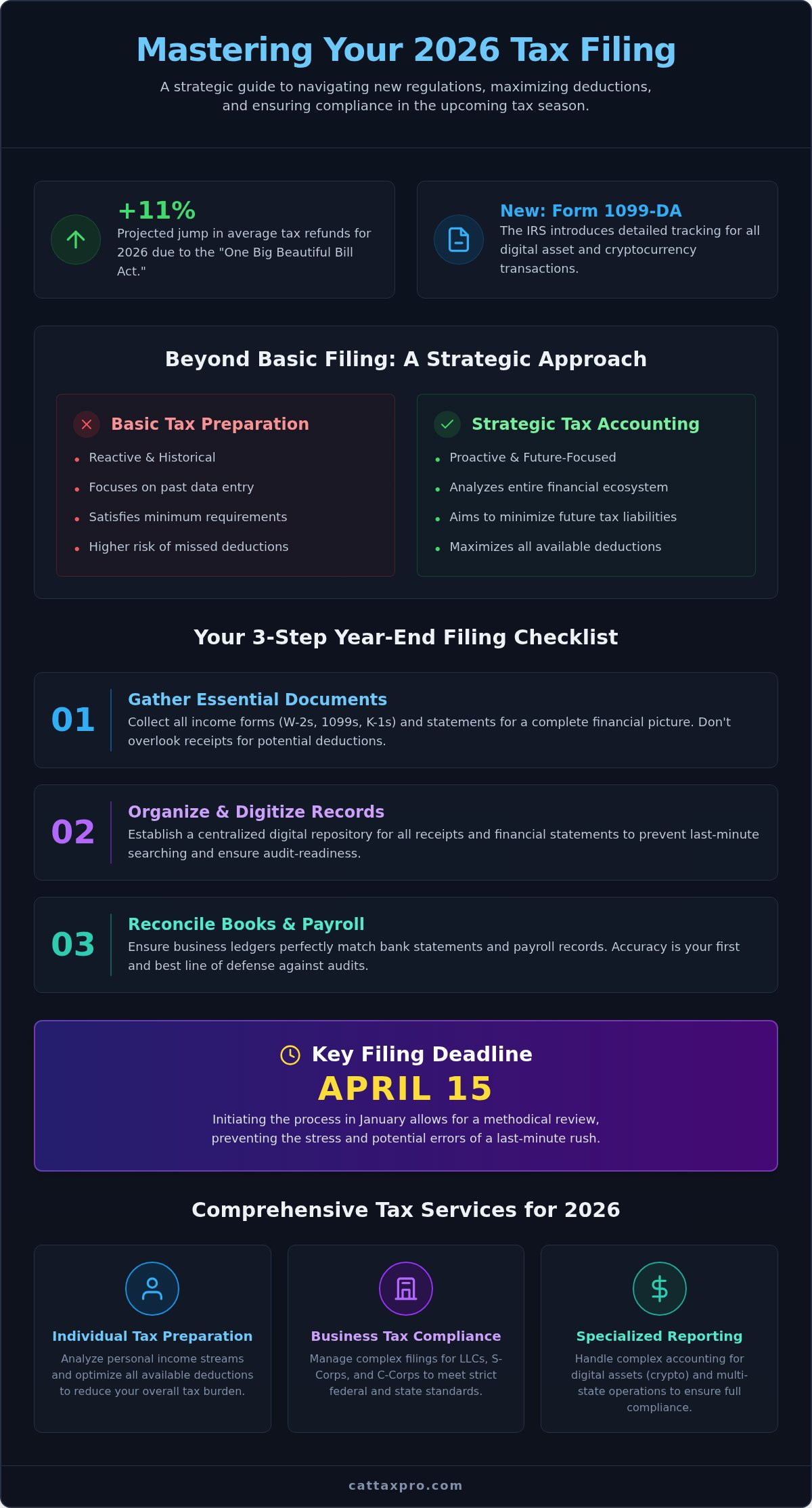
With the average tax refund jumping by over 11 percent in 2026 due to the "One Big Beautiful Bill Act," the stakes for filing precision have never been higher. You likely feel the weight of shifting regulations, especially as the IRS introduces Form 1099-DA to track digital asset transactions with unprecedented detail. It's natural to worry about potential audits or feel frustrated by disorganized records as the April 15 deadline approaches. Engaging professional year end tax filing services is the most effective way to transform this seasonal anxiety into a disciplined strategy for long term financial stability.
We believe that complex compliance shouldn't come at the cost of your peace of mind. This guide will show you how to master your year end obligations through a structured approach to documentation, maximized deductions, and professional filing strategies. You'll learn how to minimize your tax liability, avoid costly late penalties, and secure your financial standing through meticulous oversight and expert advocacy. We'll move through the essential steps to ensure your 2026 filing is both accurate and optimized for your specific business or individual needs.
Key Takeaways
- Learn how to distinguish between basic tax preparation and a strategic accounting approach to maximize your financial security.
- Identify the specific 2026 deadlines for individuals and business entities to avoid late penalties and maintain good standing with the IRS.
- Navigate the complexities of the new Form 1099-DA and cryptocurrency reporting requirements with precise cost basis tracking.
- Discover how professional year end tax filing services integrate bookkeeping and payroll to provide a seamless, audit-ready financial record.
- Understand the value of proactive IRS audit representation as a defensive measure for your long-term stability.
Understanding Year End Tax Filing Services in 2026
Engaging professional year end tax filing services is a strategic move that protects your assets and ensures full compliance with the latest tax reforms. For the 2026 tax year, this process requires a disciplined approach to documentation and a deep understanding of the evolving regulatory environment. Many see tax season as a sprint toward the April 15 deadline, but professional oversight transforms it into a structured management of fiscal obligations. It's about moving beyond simple data entry to achieve a state of comprehensive financial order.
There is a significant distinction between simple tax preparation and strategic tax accounting. Simple preparation often focuses on historical reporting, essentially looking in the rearview mirror to satisfy basic requirements. In contrast, understanding tax preparation services from a strategic perspective involves analyzing the entire financial ecosystem to identify deduction opportunities and minimize future liabilities. This method ensures that every financial decision made throughout the year aligns with current tax law, providing a sense of security and professional advocacy.
The 2026 landscape introduces specific complexities for digital asset holders. With the implementation of Form 1099-DA, the IRS now requires granular reporting for cryptocurrency transactions. This shift necessitates earlier preparation, as brokers and exchanges are now mandated to report proceeds directly. Waiting until the last minute increases the risk of discrepancies, which can trigger unwanted scrutiny. A professional partner acts as a steadfast defender, reconciling these digital records against traditional ledgers to maintain a transparent and compliant profile.
The Scope of Professional Tax Services
Comprehensive year end tax filing services provide the clarity needed to handle complex financial portfolios. Our approach organizes these services into clear, functional categories to ensure every client's long term stability:
- Individual Tax Preparation: We analyze personal income streams and optimize deductions to reduce your overall tax burden.
- Business Tax Compliance: We manage the complex requirements for LLCs, S-Corps, and C-Corps, ensuring all filings meet strict federal and state standards.
- Specialized Financial Reporting: We handle specialized accounting for digital assets and multi-state operations to provide a unified view of your tax position.
Why Timing Matters for Year-End Filing
Success in tax compliance is often a matter of timing. Initiating the process in January, rather than waiting for the April rush, allows for a more methodical review of financial records. This early start provides the necessary window to reconcile business ledgers and verify that all deductible expenses are accurately captured before the fiscal year closes. Proper timing doesn't just avoid late filing penalties; it provides the peace of mind that comes from knowing your financial house is in order well before the deadline.
How to Prepare for Year-End Filing: A Step-by-Step Guide
Precision in tax filing isn't a result of luck; it's the outcome of a methodical preparation process. Transitioning from daily financial management to year end tax filing services requires a bridge built on accurate data and clean records. This phase is about more than just checking boxes. It's about ensuring your financial narrative is bulletproof before it reaches a regulatory desk. By organizing your records now, you transform a potentially chaotic season into a disciplined exercise in wealth preservation.
Document Collection and Organization
Gathering essential income documents like W-2s, 1099s, and K-1s is your first line of defense. You should establish a centralized digital repository to house every receipt and statement. This prevents the frantic search for missing data during the height of tax season. Consult the official IRS tax preparation checklist to ensure you haven't overlooked critical forms. It's vital to distinguish between deductible business expenses and personal costs at this stage. Tracking medical expenses and charitable contributions separately allows you to maximize itemized deductions if they exceed the 2026 standard deduction of $16,100 for single filers. A tidy digital file system isn't just for convenience; it's a requirement for modern compliance.
Bookkeeping and Payroll Reconciliation
Your books must reflect reality. Reconciling business ledgers against bank statements ensures your QuickBooks or manual records are accurate. This step is where many taxpayers falter, leading to discrepancies that invite IRS scrutiny. Verifying employee tax withholdings and year-end bonus reporting is equally critical. You must address outstanding accounts receivable and payable before the fiscal year closes to ensure your income reporting is precise. If your records feel unmanageable, professional bookkeeping services can provide the necessary cleanup to prepare you for a seamless filing.
The "One Big Beautiful Bill Act" introduced several high-value opportunities for the 2026 tax year. For instance, businesses can still claim 100% bonus depreciation for qualifying property placed in service during the year. Additionally, the 20% Qualified Business Income (QBI) deduction for pass-through entities is now a permanent fixture in your planning. Identifying these credits early allows you to structure your filing for maximum benefit. Choosing a partner with IRS audit representation capabilities adds a final layer of security to your filing. You want a firm that doesn't just file forms but stands by the data as a steadfast defender. This advocacy ensures that if a question arises, you have a meticulous expert ready to manage the negotiation.
Business vs. Individual Tax Filing Requirements
The distinction between personal and commercial tax obligations creates a complex landscape for many taxpayers. While individual filers often focus on the standard deduction and W-2 income, business owners must manage a much broader set of variables. Our year end tax filing services bridge this gap by providing a unified strategy for those whose personal wealth is tied to their business performance. For S-Corporations and Partnerships, the filing deadline for Form 1120-S and Form 1065 is Monday, March 16, 2026. This earlier date requires a disciplined approach to bookkeeping to ensure that K-1s are issued in time for individual returns.
Individual filers and C-Corporations have until Wednesday, April 15, 2026, to submit their federal returns. Consulting the IRS Tax Time Guide provides a helpful baseline for routine individual requirements, but it doesn't replace the need for professional oversight in complex scenarios. For owners of pass-through entities like LLCs, business losses can often be used to offset other income on their personal returns. This interdependency requires a meticulous review of all multi-state business operations to ensure that income is correctly apportioned and that you aren't overpaying in any single jurisdiction.
Small Business Compliance Strategies
Small business owners should focus on maximizing the 100 percent bonus depreciation available for qualifying property placed in service during 2026. This provision allows for the immediate deduction of the full cost of equipment and software, which significantly lowers taxable income. It's also vital to reconcile your self-employment tax obligations and verify that all quarterly estimated payments were made accurately. Precise financial statement preparation is the foundation of a successful business return, providing the documentation needed to defend your deductions in the event of an inquiry.
High-Net-Worth Individual Considerations
For high-net-worth individuals, year end tax filing services must address the intricacies of investment income and capital gains. With long-term capital gains rates at 0, 15, or 20 percent depending on your income level, timing the sale of assets is a critical strategy. You must also account for the tax implications of real estate holdings and rental income, ensuring that all depreciation and management expenses are captured. Additionally, the current year requires a careful review of estate and gift tax considerations to protect your family's long-term financial legacy.
Specialized Reporting: Cryptocurrency and Digital Assets
Digital asset reporting has transitioned from a niche concern to a primary focus of IRS enforcement. For the 2026 filing season, the IRS maintains a broad definition of virtual currency that includes everything from traditional tokens to stablecoins and NFTs. Professional year end tax filing services are now essential for anyone with a diverse digital portfolio, as the complexity of tracking cost basis across multiple decentralized platforms often leads to reporting errors. Every sell, trade, or purchase of goods with crypto is a taxable event that must be accounted for with precision to ensure your long term stability.
The New 1099-DA Reporting Landscape
Starting in 2026, cryptocurrency brokers are mandated to issue Form 1099-DA to both taxpayers and the IRS. This document reports digital asset proceeds with the same level of transparency as traditional stock trades. While this form provides a baseline, it often fails to account for transfers between private wallets or external platforms. You must reconcile this exchange-provided data against your actual wallet activity to avoid overpaying or triggering an audit. Non-compliance with these disclosure rules carries heavy penalties, making meticulous record-keeping a non-negotiable part of your financial strategy.
Crypto Portfolio Reconciliation
High-volume traders face the daunting task of calculating capital gains and losses across thousands of transactions. Long-term capital gains on assets held over a year are taxed at 0, 15, or 20 percent, while short-term gains are taxed at ordinary income rates. Professional oversight helps identify tax-loss harvesting opportunities before the December 31 deadline, allowing you to offset gains with strategic losses. Documenting DeFi participation, staking rewards, and NFT minting ensures your portfolio is defended against potential IRS inquiries. This level of detail is necessary to project a sense of order in the face of complex regulatory requirements.
Managing digital assets requires a blend of modern technical competence and classic accounting principles. Without a structured approach, you risk miscalculating your liability or missing critical reporting deadlines. Secure your digital assets with expert cryptocurrency accounting services to ensure full compliance and achieve true peace of mind.
Choosing a Strategic Partner for Tax Defense and Filing
Selecting the right firm for your year end tax filing services is a decision that extends far beyond the April deadline. You require a partner who functions as both a strategic guide and a steadfast defender of your financial interests. While many retail preparers offer basic data entry, a professional firm provides the personalized advocacy needed to navigate high-pressure negotiations with regulatory bodies. This comprehensive approach ensures that your filing isn't just a seasonal task but a component of a well-mapped financial ecosystem designed for long term stability. It's about finding a resource that is equally comfortable with routine administrative tasks and high-stakes financial management.
The Advantage of Integrated Financial Services
Integrating your daily operations with your tax strategy is the most effective way to eliminate seasonal anxiety. Monthly Bookkeeping Services prevent year-end surprises by ensuring your data is accurate and categorized in real-time. This synergy extends to Payroll administration, where consistent oversight ensures that withholdings and bonus structures align perfectly with your tax obligations. Maintaining a meticulously reconciled ledger throughout the year provides a clear audit trail that fundamentally reduces the risk of an IRS inquiry. By leveraging QuickBooks Setup and Training, you improve your internal financial controls and gain a clearer understanding of your business’s fiscal health. This proactive management allows for strategic planning that happens in January, rather than a reactive scramble in April.
Securing Professional IRS Audit Representation
The true value of a professional tax partner is most evident when facing an IRS inquiry. You should look for a firm that includes IRS Audit Representation as a core component of their service offering. This specialized advocacy means that if you receive a letter or notice, you have a meticulous expert ready to handle the technical response and negotiate on your behalf. Professional representation transforms a high-stakes confrontation into a managed administrative process, allowing you to maintain your focus on your business or personal life. When you choose year end tax filing services that include defense, you aren't just buying a form; you're securing a steadfast partner who stands between you and regulatory scrutiny. It's about achieving a sense of security and order, even in the face of complex regulatory requirements.
Protect your finances with professional tax preparation and audit defense and secure your long-term stability with a partner who stands by your side year-round.
Securing Your Financial Future for 2026 and Beyond
Mastering your tax obligations requires a proactive commitment to financial integrity. We've explored how identifying the specific requirements for pass-through entities and digital assets can shield your wealth from unnecessary risk. Engaging professional year end tax filing services ensures that every deduction is captured and every regulatory requirement is satisfied with meticulous precision. By moving from a reactive stance to a disciplined strategy, you achieve the peace of mind that comes with complete compliance and a well-ordered financial ecosystem.
Catherine Accounting & Tax Services LLC stands as your steadfast defender, providing the expert oversight necessary to navigate the complexities of the modern fiscal landscape. Our team features IRS Audit Representation Specialists and QuickBooks Certified ProAdvisors who are dedicated to your long-term stability. We offer Comprehensive Crypto Accounting Solutions to resolve the challenges of digital asset reporting and cost basis reconciliation. Don't leave your financial security to chance. Schedule your year-end tax consultation with Catherine Accounting & Tax Services LLC today to ensure your 2026 filing is handled with professional authority and care. You've worked hard to build your financial foundation; we're here to help you protect it.
Frequently Asked Questions
What is the deadline for filing year-end taxes in 2026?
The federal deadline for individuals and C-Corporations to file their 2025 income taxes is Wednesday, April 15, 2026. For pass-through entities like S-Corporations and Partnerships, the deadline is earlier, falling on Monday, March 16, 2026. While you can obtain an extension to October 15, any tax payments due must still be submitted by the original April deadline to avoid interest charges and late payment penalties.
Do I need a professional tax preparer if I already use QuickBooks?
QuickBooks is an excellent tool for organization, but it doesn't provide the strategic oversight required for complex year end tax filing services. Professional accountants reconcile your digital data against bank statements to identify errors that software might overlook. We offer QuickBooks Setup and Training to ensure your internal records are accurate, which ultimately provides a stronger foundation for audit defense and long-term financial stability.
What documents do I need for my small business year-end filing?
You should gather all income-reporting documents, including W-2s for employees and 1099-NEC forms for independent contractors. Essential records also include reconciled business ledgers, bank statements, and documentation for major equipment purchases eligible for 100 percent bonus depreciation. Having these documents organized in a centralized digital repository allows for a more efficient and accurate filing process that stands up to regulatory scrutiny.
How are cryptocurrency gains taxed in 2026?
Cryptocurrency is taxed as property, meaning every trade or sale is a taxable capital gains event. For the 2026 filing season, you'll likely receive Form 1099-DA from brokers, which reports your digital asset proceeds directly to the IRS. Long-term gains on assets held over one year are taxed at rates of 0, 15, or 20 percent, while short-term gains are taxed at ordinary income rates based on your tax bracket.
Can a tax service help me if I have already received an IRS audit notice?
Professional IRS Audit Representation is specifically designed to manage the high-pressure environment of an active audit. Our specialists act as your steadfast defender, handling all communications with the IRS and negotiating on your behalf to resolve discrepancies. We review your original filing, identify potential issues, and provide the meticulous documentation required to satisfy regulatory inquiries and protect your financial standing throughout the entire negotiation process.
What is the difference between tax preparation and tax planning?
Tax preparation is the historical act of filing required forms based on past financial activity. Tax planning is a proactive, year-round strategy focused on minimizing your future liability through structured investments and deduction timing. While preparation satisfies your immediate legal obligations, planning ensures your financial ecosystem is optimized for long-term growth. Both are essential components of comprehensive year end tax filing services for high-net-worth individuals and businesses.
How can I maximize my business deductions before the year ends?
You can maximize your deductions by utilizing the 100 percent bonus depreciation on qualifying property placed in service before December 31. Reconciling your payroll and ensuring all business-related travel is documented at the 2026 rate of 72.5 cents per mile also captures significant value. Engaging professional services early allows for a thorough review of your ledger to identify any missed expense opportunities before the fiscal year officially closes.
What happens if I miss the year-end tax filing deadline?
Missing the deadline triggers failure-to-file and failure-to-pay penalties, which can significantly increase your total balance due. The IRS typically charges a penalty of 5 percent of the unpaid taxes for each month that a tax return is late. If you can't file on time, submitting Form 4868 for an extension provides six additional months to file, though it doesn't grant more time to pay the estimated taxes owed.


