
Would you trust an automated tax form that only tells half the story of your financial year? With the mandatory rollout of Form 1099-DA in 2026, many investors are discovering that exchange-reported data often lacks the critical cost basis information needed for true accuracy. If you're struggling to reconcile complex DeFi transactions or staking rewards, you're not alone. The burden of proof remains firmly on your shoulders, making professional cryptocurrency accounting services essential for maintaining audit-readiness in this new era of mandatory FIFO reporting.
We understand the pressure of managing high transaction volumes while fearing an IRS inquiry. You deserve the peace of mind that comes from knowing your digital assets are integrated seamlessly into your traditional business ledgers. This guide provides the expert strategies you need to handle the latest FASB standards and SEC-CFTC regulations with confidence. We'll outline the specific steps to transform chaotic wallet histories into disciplined, audit-proof financial records that protect your long-term stability.
Key Takeaways
- Gain clarity on the 2026 IRS landscape and how the Infrastructure Investment and Jobs Act impacts your digital asset reporting obligations.
- Discover how specialized cryptocurrency accounting services employ forensic cost-basis reconstruction to ensure accuracy across multiple wallets and exchanges.
- Master the integration of crypto data into traditional business ledgers using QuickBooks to maintain a comprehensive and organized financial overview.
- Follow a disciplined five-step process to build an audit-proof framework that protects your portfolio from regulatory challenges.
- Understand the strategic value of professional IRS representation in defending your high-volume transaction history against scrutiny.
The Evolving Landscape of Cryptocurrency Accounting in 2026
Professional crypto accounting represents the systematic tracking, valuation, and classification of digital assets to ensure precise tax compliance. It is a disciplined practice that bridges the gap between decentralized activity and the rigorous standards of the IRS. In 2026, the complexity of this task has escalated significantly. The Infrastructure Investment and Jobs Act, combined with the GENIUS Act of July 2025, has fundamentally reshaped how digital assets are monitored and reported. These legislative changes transitioned the market from a period of relative ambiguity into a highly regulated environment where every transaction is visible to authorities.
Traditional bookkeeping methods frequently fail when applied to decentralized finance (DeFi). Standard ledgers aren't built to interpret liquidity pool tokens, yield farming rewards, or complex smart contract interactions. This is why cryptocurrency accounting services have become a vital resource for both individuals and businesses. A professional accountant does more than just record trades; they verify third-party exchange data against on-chain reality to ensure your records are defensible. This forensic approach is necessary because exchange reports are often incomplete, failing to account for transfers between private wallets or the nuances of wrapped tokens.
IRS Property Treatment vs. New Broker Reporting
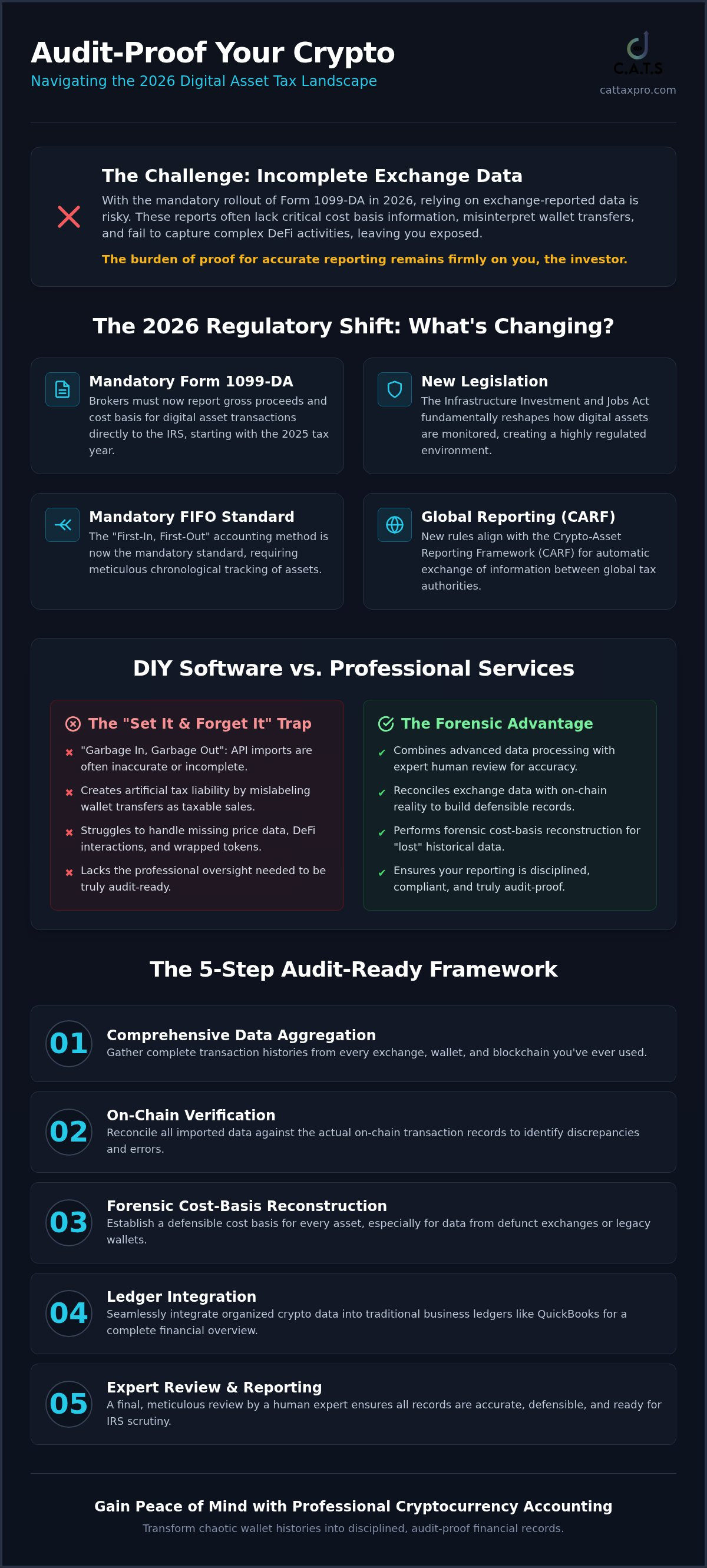
The IRS maintains its stance that virtual currency is property for gain and loss purposes. This means that every trade, sale, or purchase of goods using crypto remains a taxable event. However, the mechanism for reporting these events has changed. We have moved from a system of voluntary self-reporting to the standardized 1099-DA cryptocurrency reporting requirements. Starting with the 2025 tax year, brokers must report gross proceeds and, in many cases, cost basis directly to the IRS. This shift mirrors the Crypto-Asset Reporting Framework (CARF), which establishes a global standard for the automatic exchange of information between tax authorities. Professional services are now essential to reconcile discrepancies between these new 1099-DA forms and your actual transaction history, ensuring you don't overpay due to exchange errors.
Why 'DIY' Crypto Software is Often Insufficient
Many investors rely on automated API imports from popular tax software, but this "set it and forget it" approach is dangerous. Automated tools often struggle with the "Garbage In, Garbage Out" problem. If the software can't identify a transfer between your own wallets, it may incorrectly label that movement as a taxable sale, creating an artificial tax liability. These platforms also frequently fail to account for the mandatory FIFO accounting method that became the standard in 2026. While software provides a baseline, it lacks the professional oversight needed to handle missing price data or the complex "Travel Rule" requirements enforced by FinCEN. A meticulous review by a human expert is the only way to ensure your records are truly audit-ready in 2026.
Core Cryptocurrency Accounting Services for Investors and Businesses
The era of simple automated reporting has ended. As the IRS intensifies its focus on digital assets, professional cryptocurrency accounting services provide the forensic oversight necessary to reconcile fragmented transaction histories across multiple blockchains. We don't just rely on automated imports; we apply a disciplined, hybrid approach that combines advanced data processing with expert human review. This ensures your records meet the latest IRS crypto reporting requirements while protecting you from the inaccuracies common in exchange-generated forms. Specialized support is also critical for high-frequency trading firms and NFT creators who handle thousands of micro-transactions that often trigger 1099-K reporting thresholds.
Cost-Basis Reconstruction and Historical Reporting
A primary challenge for long-term investors is identifying "lost" cost basis from defunct exchanges or legacy private wallets. When an exchange closes or data becomes inaccessible, the burden of proof for your acquisition price remains with you. Our forensic reconstruction process tracks every movement of your assets to establish a defensible cost basis. We handle complex scenarios like wrapped tokens and bridge transactions, which often trigger incorrect taxable events in basic software. Following the April 2026 FASB updates, our methodology reflects the latest standards for these assets, ensuring a consistent and logical methodology across multiple tax years.
Income Tracking for DeFi and Web3 Activities
DeFi participation creates a dense web of ordinary income and capital gains that requires meticulous classification. We track and report income from staking, airdrops, and hard forks at their fair market value at the exact time of receipt. This is vital for liquidity pooling, where the distinction between earning a fee and experiencing a taxable trade is frequently blurred. For businesses, we manage the complexities of DAO participation and governance token rewards. If your firm utilizes digital assets for compensation, we provide strategic frameworks for payroll and bookkeeping services that integrate crypto-based compensation into your traditional business records with total accuracy. We act as your strategic guide, ensuring that every digital reward is accounted for without creating unnecessary tax liabilities.
Bridging Digital Assets with Traditional Business Accounting
Accepting digital assets as payment is a forward-thinking move, but it introduces significant administrative complexity. Every transaction requires a precise USD valuation at the exact moment of exchange to satisfy IRS guidelines on digital asset taxation. Without a disciplined system, your general ledger quickly becomes a chaotic mix of volatile asset data and traditional fiat entries. This creates a dual-currency headache that can lead to costly errors during tax season. Professional cryptocurrency accounting services resolve this by mapping every on-chain movement to a corresponding entry in your general ledger, providing a clear and defensible financial trail.
Payroll administration adds another layer of difficulty, especially for companies paying global contractors in stablecoins. In 2026, the IRS expects the same level of reporting for digital compensation as it does for cash wages. We help you establish a structured payroll framework that tracks basis, calculates withholdings, and ensures that your 1099 or W-2 filings are accurate. This methodical approach protects your business from penalties while allowing you to leverage the speed and efficiency of blockchain-based payments.
QuickBooks Integration for Crypto-Friendly Businesses
We specialize in mapping complex wallet activity directly to your QuickBooks accounts. This process involves more than just importing data; it requires a categorical approach to ensure that payments, fees, and rewards are classified correctly. By utilizing our small business accounting solutions, you can ensure your entity is prepared for the 2026 regulatory environment. We also provide QuickBooks training for your internal staff, empowering them to manage routine entries while we handle the high-level forensic reconciliation. This partnership ensures your records remain organized and your team stays productive.
Business Tax Planning and Compliance
Strategic planning is essential for businesses holding digital assets on their balance sheets. The timing of a sale can significantly impact your corporate tax liability. If your business experienced a high-income quarter, harvesting losses from a crypto downturn can offset those gains. We analyze your portfolio to identify these opportunities throughout the year. This level of management is critical for crypto-native enterprises that must report significant holdings under the 2026 FASB standards. Our cryptocurrency accounting services act as a steadfast defender of your bottom line, ensuring you only pay what you truly owe.
Building an Audit-Ready Framework for Your Portfolio
The high-stakes nature of digital asset taxation in 2026 requires more than just a reactive approach. With the IRS utilizing sophisticated blockchain analytics and receiving direct data via Form 1099-DA, your financial records must be beyond reproach. A defensible record isn't built during an audit; it's constructed through disciplined, month-to-month reconciliation. Our cryptocurrency accounting services focus on creating a complete and well-mapped financial ecosystem that stands up to the most rigorous regulatory inquiries. By establishing this framework early, you transform a source of anxiety into a position of secure, organized strength.
Documentation is the cornerstone of any successful defense. The IRS expects to see a granular level of detail, including timestamps, wallet addresses, and the specific fair market value for every transaction. This is particularly true for users with high transaction volumes or those involved in complex staking and DeFi protocols. We act as your strategic guide, ensuring that every digital interaction is backed by a verifiable data trail that satisfies the Bank Secrecy Act's Travel Rule and other federal requirements.
The 5 Steps to Professional Crypto Reconciliation
Our methodical process ensures that no detail is overlooked and every asset is accounted for accurately. We follow these five categorical steps to prepare your portfolio for tax season:
- Step 1: Data Aggregation. We collect all API keys and CSV exports from every exchange and private wallet you've used, ensuring we have the complete "puzzle" of your trading history.
- Step 2: Transaction Classification. Our team meticulously identifies the nature of every movement, distinguishing between simple transfers, taxable trades, and ordinary income from rewards.
- Step 3: Anomaly Detection. We resolve the "Garbage In, Garbage Out" problem by manually fixing pricing errors and closing missing cost-basis gaps that automated software often misses.
- Step 4: Tax Optimization. We apply the most favorable legal accounting methods, such as the mandatory FIFO standard for 2026, to ensure your liability is calculated with total precision.
- Step 5: Final Review. Our licensed professionals generate audit-ready reports and IRS Form 8949, providing a final signature of accuracy on your financial data.
Expert IRS Audit Representation for Crypto Users
Receiving an automated IRS "CP2000" notice or a formal audit letter can be a high-pressure experience. These notices often result from discrepancies between exchange-reported data and your own filings. As your steadfast defender, we handle all direct communication with regulatory bodies, presenting your reconciled records with professional authority. This advocacy ensures that the IRS sees a clear, logical explanation for your transaction history rather than a series of red flags. You can move forward with confidence knowing that a licensed expert is managing the complexities of IRS audit representation on your behalf. The peace of mind that comes from professional advocacy allows you to focus on your investments while we protect your long-term financial stability.
Why Catherine Accounting & Tax Services LLC is Your Crypto Partner
Catherine Accounting & Tax Services LLC combines the disciplined foundations of classic accounting with an advanced understanding of modern digital financial landscapes. In an era where regulatory bodies are aggressively monitoring blockchain activity, you need more than a software subscription. You require a partner who functions as both a strategic guide and a steadfast defender. Our cryptocurrency accounting services provide a comprehensive, one-stop resource for high-stakes financial compliance. We manage everything from routine bookkeeping and payroll to complex IRS audit representation. This national reach ensures that whether you're an individual investor or a growing business, your assets are protected by professional authority and meticulous oversight.
A Supportive and Meticulous Approach
We understand that the complexities of 2026 tax law can create significant anxiety for digital asset holders. Our team alleviates this stress through a structured and logical approach to financial planning. We don't just react to tax season; we position your finances for long-term stability by staying current with every FASB update and IRS procedural change. By maintaining a meticulous focus on detail, we bring a sense of order to the volatile world of crypto. This disciplined management ensures that your records are not only compliant but also optimized for your specific financial goals. We pride ourselves on being accessible to those seeking help with sensitive financial issues, offering a blend of professional authority and reassuring advocacy.
Getting Started with Professional Crypto Support
Your journey toward total compliance begins with a thorough portfolio review and initial consultation. During this process, we identify gaps in your historical data and establish a proactive strategy for the coming year. A reactive relationship with your accountant often leads to missed opportunities and increased audit risk. By contrast, our proactive partnership ensures that every trade is documented as it happens. We provide the specialized support needed for 1099-DA reporting and QuickBooks setup and training, bridging the gap between your digital and traditional ledgers. Our firm is equally comfortable navigating routine administrative tasks as we are handling high-pressure negotiations with regulatory bodies. Secure your financial peace of mind with Catherine Accounting and ensure your digital legacy is built on a foundation of professional excellence.
Secure Your Digital Legacy in the New Era of Transparency
The 2026 tax landscape demands a shift from reactive filing to proactive, disciplined management. With the IRS now receiving standardized data through Form 1099-DA, the burden of proving your cost basis has never been more critical. You've worked hard to build your portfolio; don't let fragmented data or automated software errors jeopardize your financial security. Our comprehensive cryptocurrency accounting services provide the forensic oversight necessary to reconcile complex DeFi activities and ensure your records are truly audit-ready.
We offer the specialized 1099-DA reconciliation and Licensed QuickBooks ProAdvisor training required to bridge the gap between digital innovation and traditional fiscal stability. If you're facing a regulatory inquiry, our expert IRS audit representation serves as your steadfast defender. Schedule a Consultation for Cryptocurrency Accounting Services today to bring order to your digital assets and protect your bottom line. You can move forward with confidence knowing your compliance is handled by a partner committed to your long-term peace of mind.
Frequently Asked Questions
How do I know if I need professional cryptocurrency accounting services?
You should consider professional cryptocurrency accounting services if your digital asset activity involves high transaction volumes, multi-wallet interactions, or participation in decentralized finance (DeFi) protocols. Manual tracking becomes prone to error when dealing with liquidity pools and staking rewards. If you receive a 1099-DA that doesn't reflect your true cost basis, a professional can reconstruct your history to prevent overpayment and ensure your filings are audit-ready.
What is the 1099-DA form and how does it affect my 2026 taxes?
Form 1099-DA is a new information return that crypto brokers must issue to both the IRS and taxpayers starting with the 2025 tax year, which you'll file in 2026. It reports gross proceeds and, in many instances, the cost basis of digital asset sales. Because these forms often lack data for assets transferred from private wallets, you'll need to reconcile them against your on-chain records to ensure the IRS doesn't assume a zero-dollar cost basis on your gains.
Can you help if I have lost my transaction history from a closed exchange?
We assist in recovering lost data through forensic reconstruction of your on-chain wallet movements. Even if an exchange has closed, the "other side" of those transactions usually exists on the blockchain. Our team tracks these transfers to establish a defensible cost basis for your assets. This methodical approach ensures you aren't penalized for missing exchange records and maintains the integrity of your long-term financial stability.
How does professional accounting differ from using crypto tax software?
Professional accounting provides expert human oversight that identifies and corrects the "Garbage In, Garbage Out" errors common in automated software. While software can aggregate data, it often mislabels transfers between your own wallets as taxable sales. Our cryptocurrency accounting services include a meticulous review of every transaction to ensure correct classification, especially for complex events like wrapped tokens or bridge transactions that software frequently misinterprets.
Is DeFi staking considered ordinary income or capital gains?
Staking rewards are treated as ordinary income based on their fair market value at the time you receive possession of the tokens. This establishes your cost basis for that specific asset. When you eventually sell or swap those tokens, any change in value from that initial receipt price is then treated as a capital gain or loss. We track these values precisely to ensure your income reporting is accurate and compliant with current standards.
What happens if I haven't reported my crypto trades in previous years?
If you have unreported trades from prior years, the most effective course of action is to file amended tax returns to correct the oversight. The IRS has increased its enforcement capabilities through blockchain analytics, and proactive disclosure is viewed more favorably than discovery during an audit. We provide the expertise needed to reconstruct historical data and represent you during the amendment process, functioning as a steadfast defender of your interests.
Can you integrate my crypto trading into my business QuickBooks?
We specialize in integrating digital asset transaction data directly into traditional business general ledgers using QuickBooks. Our team maps your wallet activity to specific accounts, ensuring that business payments, gas fees, and rewards are categorized correctly. This process creates a unified financial ecosystem where your crypto activity is as organized and transparent as your fiat operations, providing a complete and well-mapped view of your firm's financial health.
How do you protect my data during the accounting process?
We protect your sensitive financial information through secure, encrypted portals and disciplined data management protocols. Our firm prioritizes the security of your API keys and CSV exports, ensuring that access is restricted only to the licensed professionals handling your file. This commitment to security provides the peace of mind you need when sharing complex financial data, reflecting our role as a stable and protective partner in your regulatory compliance journey.


