

The IRS has officially ended the "honor system" for digital assets. For many investors, the transition to the new 1099-da cryptocurrency reporting requirements will be a significant wake-up call during the 2026 tax season. It's understandable to feel a sense of unease as the government gains direct visibility into your exchange activity. Managing fragmented data across multiple platforms and private wallets is already a heavy lift, and the fear of facing penalties for incorrect cost-basis reporting is a valid concern for any serious participant in the digital economy.
You deserve a clear path through this regulatory shift. This guide provides the professional clarity you need to master the new digital asset reporting standards and ensure your crypto portfolio remains fully compliant. We will examine the specific reporting thresholds for NFTs and stablecoins, explain why some transactions still won't appear on your forms, and provide a methodical plan for reconciling missing data from your private wallets. By the end of this article, you'll have the confidence to manage your 2026 filings with precision and peace of mind.
Key Takeaways
- Understand the transition from voluntary self-reporting to mandatory broker reporting through the new Form 1099-DA and what it means for your tax privacy.
- Master the specific 1099-da cryptocurrency reporting requirements for the 2026 tax year, including critical transition relief and penalty waiver provisions.
- Identify the technical differences between Form 1099-DA and Form 1099-B to ensure your cost-basis tracking remains accurate across all custodial accounts.
- Learn how to systematically audit your 1099-DA against your personal transaction history to reconcile missing data and avoid automated reporting errors.
- Recognize the limitations of basic tax software and how professional cryptocurrency accounting services bridge the gap between complex blockchain data and IRS compliance.
What is Form 1099-DA? Understanding the New Standard for Digital Assets
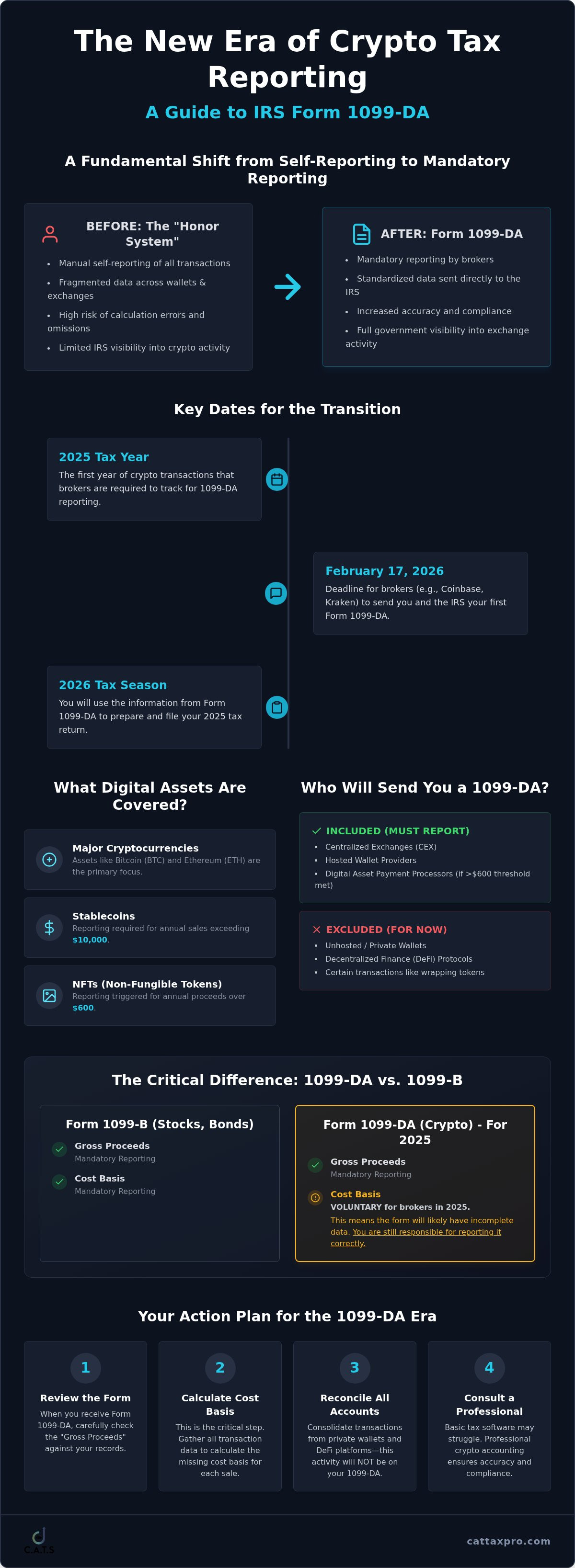
The Internal Revenue Service has introduced Form 1099-DA, which stands for "Digital Asset Proceeds From Broker Transactions." This document represents a fundamental shift in how the federal government monitors the crypto economy. For years, the IRS relied on a self-reporting system where taxpayers were responsible for tracking every trade and transfer manually. That era is ending. The primary goal of the 1099-da cryptocurrency reporting requirements is to close the "tax gap," which refers to the billions of dollars in unpaid revenue the Treasury Department attributes to the digital asset sector.
By requiring third-party brokers to report transactions directly to the government, the IRS gains a level of visibility previously reserved for traditional stocks and bonds. While the Infrastructure Investment and Jobs Act of 2021 set this in motion, 2026 is the critical year for investors. This is the year when brokers will issue the first batch of forms covering activity from the 2025 tax year. It's a move toward consistency. It ensures that every participant in the market operates under the same set of transparent rules, providing a sense of order in a historically fragmented financial landscape.
Digital Assets Covered Under the New Rules
The scope of these regulations is broad. It encompasses nearly every category of digital value held on centralized platforms. Understanding which assets trigger a form is essential for maintaining a compliant portfolio. The following assets are primary targets for the new reporting standards:
- Major Cryptocurrencies: Assets like Bitcoin and Ethereum are the primary focus of these reporting rules.
- Stablecoins: These assets have unique reporting nuances. For instance, qualifying stablecoin sales only trigger reporting requirements if they exceed a $10,000 annual threshold.
- NFTs: Specified non-fungible tokens are also covered. The IRS has set a reporting threshold of $600 per year for these assets.
- Tokenized Real-World Assets: As traditional finance moves on-chain, tokenized versions of real estate or commodities are increasingly falling under the digital asset umbrella.
Who is Considered a "Broker" by the IRS?
The IRS definition of a "broker" determines which entities must issue these forms to you. Currently, this includes centralized exchanges (CEX) and hosted wallet providers that facilitate sales or exchanges. Digital asset payment processors are also included, provided they meet the $600 annual transaction threshold. It's helpful to know that the regulatory landscape for decentralized finance (DeFi) has shifted. A Treasury rule that would have classified certain DeFi platforms as brokers was repealed on April 10, 2025. This means that, for the current 2026 filing season, the burden of reporting falls primarily on custodial, centralized entities rather than unhosted wallets or decentralized protocols.
Deep Dive: 1099-DA Reporting Requirements for the 2026 Tax Year
The 2026 tax season marks a pivotal shift for every digital asset owner in the United States. Understanding the 1099-da cryptocurrency reporting requirements isn't just about identifying a new form; it's about interpreting the specific technical rules the IRS has established during this transition period. To manage the complexity of this rollout, the IRS issued Notice 2024-56, which provides essential transition relief. This notice offers penalty waivers for brokers who demonstrate a good-faith effort to comply, acknowledging that the infrastructure for such massive data sharing takes time to perfect. You can find the most current official resources on the page About Form 1099-DA.
While Notice 2024-56 focuses on the brokers, Notice 2024-57 identifies specific transactions that are currently excluded from these requirements. For instance, wrapping tokens or certain liquidity provider activities don't yet trigger a 1099-DA. For the transactions that are covered, brokers are only mandated to report "Gross Proceeds" for the 2025 tax year. Cost basis reporting remains voluntary for this initial phase. This means the form you receive in early 2026 might show how much you received from a sale, but it won't necessarily show what you paid for the asset. Brokers must furnish these forms to you by February 17, 2026, though major exchanges like Coinbase and Kraken have signaled potential delays into mid-March. If you're concerned about these delays affecting your filing timeline, our cryptocurrency accounting services can help you prepare your own data in advance.
Critical Reporting Thresholds and De Minimis Rules
The IRS has established specific dollar amounts to filter high-volume, low-value transactions. Digital asset payment processors only need to report if your annual transactions exceed $600. For qualifying stablecoin sales, the reporting threshold is significantly higher at $10,000 per year. Specified NFT sales also carry a $600 annual threshold. It's a common mistake to assume that failing to receive a form means the income is tax-free. You're still legally required to report all gains and losses, regardless of whether a broker issues a 1099-DA. These de minimis rules only change what the broker reports, not your personal liability.
Specific Transaction Types Triggering a 1099-DA
The scope of the new reporting mandate covers several common actions. Selling digital assets for fiat currency like USD is the most direct trigger. However, exchanges of one digital asset for another, often called crypto-to-crypto trades, are also included. If you swap Bitcoin for Ethereum, the broker will record that as a sale of Bitcoin. Additionally, using digital assets to pay for goods or services will trigger a report if the transaction is processed through a covered broker. Each of these events creates a taxable disposal that must be reconciled against your original purchase price to determine your final tax obligation.
1099-DA vs. 1099-B: Navigating the Technical Differences
Historically, many cryptocurrency exchanges issued Form 1099-B to report capital gains and losses. This was always a temporary solution, as 1099-B was designed for traditional securities like stocks and bonds. The introduction of the 1099-da cryptocurrency reporting requirements signifies a move toward a form that specifically accounts for the nuances of the blockchain. Unlike the 1099-B, which focuses on ticker symbols and share quantities, the 1099-DA includes fields for wallet addresses and transaction hashes. This provides the IRS with a direct map of your digital footprint, making it much harder to omit transactions from your tax return.
One of the most significant technical shifts involves how cost basis is handled. In the world of traditional finance, brokers share data seamlessly. If you move Apple stock from one brokerage to another, your cost basis usually follows the asset. In the crypto space, this infrastructure doesn't fully exist yet. Digital assets acquired before January 1, 2026, or those transferred into an exchange from a private wallet, are classified as "noncovered securities." For these assets, your broker is only required to report the gross proceeds of a sale, leaving the burden of proving the original purchase price entirely on you.
The Cost Basis Nightmare: Why 1099-DA Data Might Be Wrong
The biggest risk for investors in 2026 is the "zero-basis" trap. When you transfer Bitcoin from a cold storage device like a Ledger to a centralized exchange to sell it, the exchange doesn't know what you originally paid for that Bitcoin. Without that data, the exchange may report a $0 cost basis to the IRS on your 1099-DA. This could result in you being taxed on the entire sale price rather than just your actual profit. To avoid this, you must maintain your own meticulous records. We recommend using a comprehensive individual tax preparation checklist to ensure you have the receipts and timestamps necessary to override incorrect broker data.
Reporting Wash Sales and Airdrops
Currently, the IRS stance on crypto wash sales differs from traditional stocks. For the 2026 tax season, digital assets are still largely treated as property, meaning the strict 30-day wash sale rules that apply to stocks don't yet apply to crypto. However, this is a high-scrutiny area, and aggressive tax loss harvesting could still be challenged under "economic substance" rules. Additionally, keep in mind that Form 1099-DA is primarily for sales and exchanges. Income from airdrops, hard forks, or staking rewards often won't appear on this form. These are generally treated as ordinary income and may be reported on a 1099-MISC instead. Reconciling these different forms is a critical step in building a complete and compliant tax profile.
Action Plan: What to Do When You Receive a 1099-DA
Receiving your first Form 1099-DA doesn't mean your tax preparation is finished. It simply means the IRS has received a data point that must now be reconciled against your actual financial activity. The 1099-da cryptocurrency reporting requirements place the ultimate burden of proof on the taxpayer, not the exchange. Your first step is a comprehensive audit. Compare every line item on the form against your own transaction history. Pay close attention to Box 5, which indicates whether the cost basis was reported to the IRS. If this box is blank or checked "No," the IRS assumes a $0 basis, which could lead to an inflated tax bill.
Reconciling off-platform transfers is the most critical phase of this action plan. If you moved assets from a private wallet to an exchange, that broker likely lacks the data to calculate your profit accurately. You must bridge this gap by tracing the asset back to its original acquisition. Once your data is verified, integrate these figures into Form 8949 and Schedule D. If you find significant discrepancies, contact the broker's support team immediately to request a corrected form. If the exchange refuses to update the data, don't panic. You can still report the correct figures on your return, provided you include a statement of explanation to preemptively address IRS red flags.
Handling Errors on Your 1099-DA
Broker errors are common during the initial rollout of new tax forms. If your 1099-DA contains incorrect proceeds or basis information, follow a disciplined resolution path. First, submit a formal request for a corrected form through the exchange's tax portal. If they cannot or will not issue a correction, you must maintain a "defensive" tax posture. This involves filing your return with the accurate data and attaching a clear, concise statement explaining why your figures differ from the broker's report. This transparency demonstrates a good-faith effort toward compliance and can often prevent an automated audit trigger.
Documentation Requirements for 2026
Your tax return is only as strong as the evidence supporting it. For the 2026 tax year, you should retain all CSV files, API logs, and wallet addresses for at least six years. Use blockchain explorers to verify the timestamps and values of your self-custody trades. This level of detail is exhausting but necessary to defend your portfolio against IRS scrutiny. For investors with high transaction volumes or complex DeFi activity, our cryptocurrency accounting services provide the professional oversight needed to ensure every transaction is accounted for and every liability is minimized. We can help you transform a confusing pile of data into a stable, compliant tax strategy.
Why Crypto Accounting is Essential in the 1099-DA Era
The introduction of the 1099-da cryptocurrency reporting requirements has led many investors to rely on automated tax software as a quick fix. While these tools can aggregate data, they often suffer from a "Garbage In, Garbage Out" problem. Software lacks the ability to interpret the intent behind a transaction; it cannot distinguish between a high-risk security exploit, a lost private key, or a simple transfer between unlinked wallets. When your 1099-DA arrives with missing cost-basis data, blindly importing that "garbage" into your tax return is a direct invitation for an IRS audit. Professional accounting ensures that your blockchain data is reconciled with human logic before it ever reaches a tax form.
Strategic tax planning becomes even more critical as the IRS gains visibility into your portfolio. Beyond simple reporting, a licensed professional helps you navigate complex rules to minimize your capital gains liabilities. For instance, we can help you strategically use crypto losses to offset gains and up to $3,000 of ordinary income annually. In high-tax states like California, where marginal rates on crypto gains can approach 40% when combined with federal taxes, this level of planning is not just helpful; it's a financial necessity. Our firm bridges the gap between the raw data on the ledger and the sophisticated requirements of modern tax law.
Specialized Support for High-Volume Traders and DeFi Users
The complexity of the digital asset market extends far beyond simple "buy and hold" strategies. High-volume traders and DeFi participants face unique challenges with liquidity pools (LP) and yield farming activity, which rarely fit neatly into the boxes of a standard 1099-DA. We provide specialized support for business owners who utilize S Corp tax preparation services to manage their digital asset ventures. Whether you are an NFT creator managing royalty streams or a collector navigating tokenized real-world assets, we ensure your business structure and digital holdings remain in perfect alignment with current regulations.
Catherine Accounting: Your Steadfast Defender in Crypto Compliance
Catherine Accounting & Tax Services LLC functions as both your strategic guide and your steadfast defender. Our methodical approach to digital asset reconciliation involves a deep dive into your transaction history to ensure every disposal is matched with its accurate acquisition cost. We don't just prepare forms; we provide professional IRS audit representation to advocate for you if the government questions your virtual currency activity. This comprehensive reliability offers the peace of mind that comes from knowing your financial stability is protected by experts. Secure your 2026 compliance and protect your portfolio by scheduling a professional cryptocurrency tax consultation with our team today.
Securing Your Digital Asset Legacy for the 2026 Tax Season
The arrival of the first Form 1099-DA signals a permanent change in the relationship between digital asset investors and the IRS. You've learned that while the new 1099-da cryptocurrency reporting requirements aim for transparency, the initial rollout is likely to be marked by data gaps and broker errors. Relying on automated imports without a manual audit of your cost basis is a risk your portfolio doesn't need to take. By maintaining meticulous records and understanding exactly which transactions the IRS now sees, you position yourself as a proactive and compliant participant in the modern financial landscape.
Success in 2026 requires more than just filling out forms; it demands a strategic defense of your capital. Our team provides specialized cryptocurrency accounting experts and meticulous IRS audit representation to handle the heavy lifting of data reconciliation. We offer comprehensive national tax compliance that bridges the gap between complex blockchain activity and precise legal standards. Get Expert Help with Your 1099-DA Crypto Reporting today to ensure your filings are accurate and your peace of mind is secure. You've worked hard to build your assets, and with the right professional partner, you can navigate these changes with absolute confidence.
Frequently Asked Questions
What happens if I sold crypto but never received a Form 1099-DA?
You are still legally required to report all digital asset income, even if a broker doesn't issue a form. The lack of a 1099-DA usually means your transactions didn't meet the specific reporting thresholds, such as the $600 limit for payment processors or the $10,000 threshold for stablecoins. You must rely on your own transaction logs and wallet history to calculate your gains and losses accurately.
Will the IRS get a copy of my 1099-DA automatically?
Yes, the IRS receives a copy of every Form 1099-DA issued by a broker at the same time it is furnished to you. This automated data sharing allows the IRS to use matching algorithms to flag tax returns that fail to disclose corresponding digital asset proceeds. Consistent reporting is essential to avoid automated notices or underreporting penalties.
How do I report crypto losses on my 2026 tax return using 1099-DA?
You report crypto losses by reconciling your 1099-DA data on Form 8949 and transferring the final totals to Schedule D. Even if your broker only reports gross proceeds, you can use your independent records to prove a higher cost basis. This allows you to claim a capital loss that offsets other gains and up to $3,000 of ordinary income.
Do I need to report transfers between my own wallets on Form 1099-DA?
No, transfers between your own wallets are not taxable events and should not be reported as sales. However, the 1099-da cryptocurrency reporting requirements can sometimes lead to brokers misidentifying a transfer as a disposal if the destination is unknown. If this happens, you must provide documentation to show the asset remained under your control to avoid unnecessary taxation.
Can I use Form 1099-DA to report NFT sales?
Yes, Form 1099-DA is used to report specified NFT sales that exceed the $600 annual threshold. While the reporting infrastructure for NFTs is still evolving, custodial platforms that facilitate these trades are now mandated to track and report these proceeds. You should match these forms against your own records to ensure the digital art or collectibles are categorized correctly.
What should I do if the cost basis on my 1099-DA is zero but I paid for the asset?
You should override the zero cost basis on your tax return using your own verified acquisition records. If your 1099-DA shows a blank or zero in the cost basis column, it's often because the asset was transferred from a private wallet. You must provide the actual purchase price on Form 8949 to ensure you are only taxed on your true capital gains.
Are stablecoin conversions considered taxable events under the new reporting rules?
Yes, conversions between stablecoins or from stablecoins to other assets are taxable events, though specific reporting thresholds apply. Qualifying stablecoin sales only trigger a 1099-DA if they exceed $10,000 annually. Regardless of whether a form is issued, any realized gain or loss from the conversion must be reported on your federal tax return.
How does 1099-DA reporting affect my small business tax filing?
Small businesses must integrate 1099-DA data into their corporate or partnership tax filings to ensure accurate bookkeeping. If your business accepts crypto as payment, these forms help reconcile the value of assets at the time of receipt versus the time of disposal. This data is critical for maintaining clean financial records and ensuring your business remains compliant with national tax standards.


